Commercial solar lead generation is different from residential lead generation. A homeowner may begin with a simple question about electricity bills or backup power. A commercial buyer often needs to consider energy usage, building ownership, roof condition, capital expenditure, operational disruption, financing, and approval from several people.
That means a commercial installer cannot rely on the same tactics used to collect large volumes of residential enquiries. The goal is not simply to fill a CRM with names. It is to identify organisations with a real energy need, reach the people who can approve a project, qualify whether the site is suitable, and secure a meaningful next step such as a feasibility review or site assessment.
This guide explains how solar installers can build a repeatable B2B lead generation process. It covers target-market selection, account research, decision-maker outreach, digital campaigns, partnerships, qualification, sales enablement, follow-up, and measurement. The advice is broadly applicable, but electricity prices, incentives, permitting, financing, and buyer behaviour differ by market. Verify local requirements and use local project data when preparing proposals.
Want a steadier pipeline of business projects? Request a strategy conversation with Rensol Marketing to review your commercial lead generation process.
Quick answer: In short, commercial solar leads are won through account research, access to decision-makers and a clear qualification standard. This guide shows how to find, reach and qualify commercial solar leads without chasing volume.
Key takeaways
- Commercial solar leads are won through account research, decision-maker access and a clear qualification standard, not raw enquiry volume.
- Pick one or two segments, build an ideal customer profile and a target-account list.
- Track commercial solar leads through feasibility, proposal and installation to see what really pays.
Table of Contents
1. Understand what makes a commercial solar lead valuable
A commercial lead is not automatically qualified because it comes from a company email address or a large building. Before investing sales time, establish whether the organisation has a plausible project and whether you can reach the right people.
Useful qualification factors include:
- Energy demand: Is the organisation’s electricity use substantial enough for a solar project to be worth assessing?
- Daytime consumption: Does the business use power during the hours when solar generation is available?
- Property authority: Does the organisation own the building, control the roof, or have permission from the landlord?
- Site suitability: Is there a viable roof, car park, or other installation area, subject to technical assessment?
- Decision access: Can you speak with the owner, finance leader, facilities manager, operations director, or another relevant stakeholder?
- Financial readiness: Is there a budget, financing route, or process for evaluating capital projects?
- Timing: Is the organisation exploring a project now, planning for a future budget cycle, or simply gathering information?
- Service fit: Can your company deliver the required system size, engineering, installation, maintenance, and geographic coverage?
Use these criteria to define a qualified lead before campaigns begin. A clear definition helps marketing, sales, and operations work from the same expectations. The same thinking applies to exclusive solar leads: define validity before you spend.
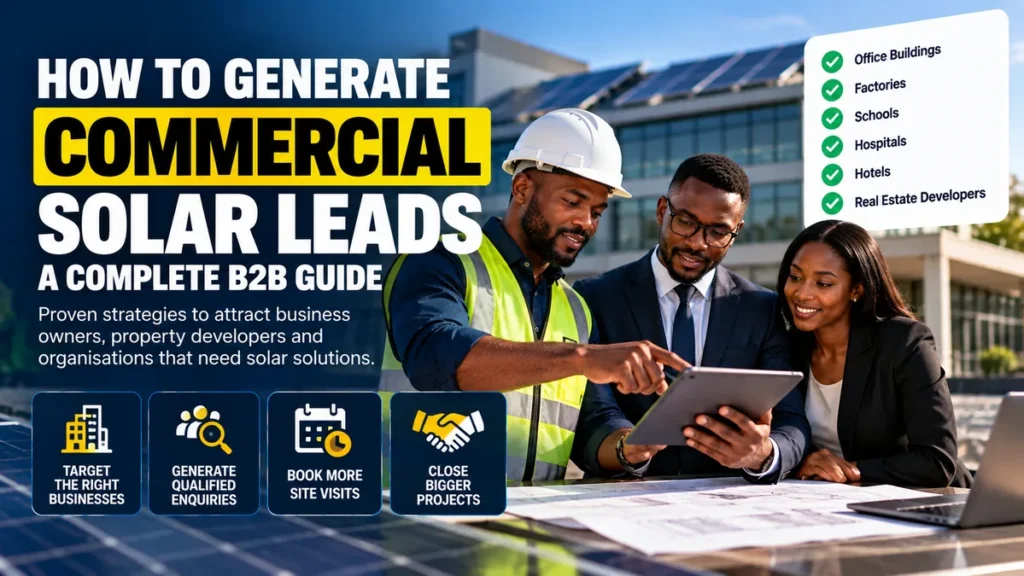
2. Choose a specific commercial segment
“Businesses that need solar” is too broad to guide a campaign. Select one or two segments where your team has relevant experience, a credible offer, and the capacity to deliver.
Potential segments include:
Factories and manufacturing facilities
Manufacturers may have substantial electricity demand and operational requirements that make reliability and cost planning important. Relevant decision-makers can include plant managers, operations directors, finance leaders, and owners.
Warehouses and logistics centres
Warehouses may have large roof areas, although roof age, structural capacity, shading, lease terms, and daytime energy use need to be assessed. Property owners, facility managers, and logistics operators may be involved.
Hotels and hospitality businesses
Hotels have energy needs related to lighting, cooling, hot water, kitchens, and guest services. A proposal should account for operating schedules, backup requirements, and the importance of minimising disruption.
Schools and educational institutions
Schools may have predictable operating hours and strong interest in resilience, but purchasing decisions can involve administrators, boards, procurement teams, or public-sector processes. Understand the approval pathway before forecasting a sales timeline.
Hospitals and healthcare facilities
Healthcare sites can have critical power requirements. Solar may be part of a broader energy strategy, but technical design, backup architecture, safety, and continuity planning require qualified professionals and careful stakeholder engagement.
Office buildings and property portfolios
Owners and managers of commercial property may evaluate solar across one building or multiple sites. A portfolio-level conversation can create opportunities for repeat work if the first assessment is successful.
Choose segments based on evidence, not assumptions. Interview existing customers, review completed projects, and ask your engineers which types of sites are technically and operationally suitable.
3. Build an ideal customer profile
An ideal customer profile (ICP) describes the type of organisation most likely to become a good customer. It is more useful than a broad audience label because it helps you decide which accounts to research and which enquiries to prioritise.
Create an ICP with fields such as:
| Attribute | Example criteria to define |
|---|---|
| Industry | Manufacturing, logistics, hospitality, education, or another chosen sector |
| Location | Areas your team can install and maintain |
| Building type | Owner-occupied facility, warehouse, campus, or portfolio |
| Energy profile | High or predictable consumption, based on available evidence |
| Property control | Owner or confirmed permission to assess the site |
| Contact roles | Owner, CFO, facilities manager, operations director, estates lead |
| Project readiness | Planning window, budget process, or active evaluation |
| Technical fit | Preliminary site indicators, subject to engineering review |
| Exclusions | Sites outside service area, unsuitable structures, or no authority to proceed |
Treat the ICP as a working hypothesis. Refine it as you learn which accounts progress from first conversation to site assessment, proposal, contract, and completed installation.
4. Build a target-account list
Commercial lead generation often begins with account research rather than a public advert. Build a list of organisations that fit your ICP and organise it so salespeople can act on it.
Potential research sources include:
- Public business directories and industry association member lists.
- Commercial property directories and property-management networks.
- Company websites and annual reports.
- Trade events, business groups, and local chambers of commerce.
- Public procurement notices where relevant.
- Existing customer and supplier networks.
- Professional networking platforms and business databases used in accordance with their terms.
Record the company name, sector, location, website, likely facility type, potential contact role, source of the information, and next action. Add a confidence field so your team can distinguish verified facts from assumptions.
Do not treat a building’s size or a company’s industry as proof of energy consumption or roof suitability. Those details require confirmation. Avoid collecting unnecessary personal data, respect applicable privacy and marketing rules, and maintain a clear opt-out process for outreach.
5. Identify the buying committee
Commercial projects may involve several stakeholders, each with different concerns. A facilities manager may care about technical fit and maintenance. A finance director may focus on cash flow, risk, and return. A business owner may prioritise reliability and long-term operating costs. A property owner may need to approve roof access or changes to the building.
Map the roles involved in:
- Recognising the energy problem.
- Evaluating technical options.
- Approving budgets.
- Authorising the property or roof.
- Reviewing contracts and risk.
- Managing installation and ongoing operations.
Your first contact does not need to be the final decision-maker, but you should understand how the decision will be made. Ask respectfully who else should be involved in a feasibility discussion rather than assuming one person can approve everything.
6. Lead with the business problem, not the equipment
Commercial buyers are not necessarily searching for a particular panel brand. They are evaluating whether a project can solve a business problem and whether the investment is justified.
Your messaging might focus on:
- Understanding the site’s electricity profile.
- Evaluating the potential contribution of solar to daytime consumption.
- Assessing backup or resilience needs as part of a broader system design.
- Reviewing operating-cost assumptions.
- Planning a project that fits the organisation’s capital and operational requirements.
- Evaluating options for one site or a portfolio.
Avoid promising a fixed percentage of savings or a guaranteed payback period without a site-specific analysis. Results depend on consumption, tariffs, system design, financing, weather, maintenance, and other variables.
A useful opening message is specific and low-pressure: “We help facilities teams assess whether rooftop solar is a practical fit for their energy profile. Would a short discussion about your site and current priorities be useful?” Adapt the language to the recipient and channel.
7. Use account-based outreach
Account-based marketing means focusing coordinated attention on a defined set of organisations rather than treating every prospect as an anonymous lead.
A simple approach:
- Select a manageable list of target accounts.
- Research each organisation and its likely energy or property context.
- Identify one or more relevant roles.
- Prepare a concise, personalised message.
- Share a useful resource, case study, or assessment offer.
- Follow up respectfully with new information or a clear question.
- Record replies, objections, referrals, and opt-outs in your CRM.
Personalisation should be genuine. Mention a relevant facility, sector challenge, or publicly available business development, but do not pretend to know the organisation’s energy bill or roof condition if you have not verified it.
Use a coordinated mix of channels only where appropriate and lawful. Keep outreach relevant, identify your company clearly, and make it easy for recipients to decline further contact. For the wider picture, read our guide on how to get more solar installation leads.
8. Use LinkedIn for professional discovery and credibility
Professional networks can help you identify roles, understand organisations, and share expertise. They should not be treated as a licence to send mass, generic pitches.
Improve your company and team profiles with clear descriptions of the commercial projects you serve, service areas, engineering capabilities, and relevant case studies. Publish content that helps facility managers and business leaders evaluate energy projects.
Useful content includes:
- A walkthrough of a completed commercial installation.
- A plain-language explanation of a feasibility study.
- A checklist for preparing a building for assessment.
- A discussion of common project risks and how they are evaluated.
- A case study explaining the client’s original problem and the solution delivered.
- Answers to questions about maintenance, warranties, and installation planning.
When contacting a prospect, connect the message to their role and business context. Ask for a short conversation or permission to share a relevant resource rather than pushing immediately for a large project commitment.
9. Create commercial landing pages and lead magnets
Your website should have a dedicated commercial solar page rather than forcing business buyers to navigate a residential-focused experience. More on building the full system in our guide to solar marketing strategies.
A strong page explains:
- Which types of organisations you serve.
- The commercial problems you help assess.
- Your process from discovery to feasibility, proposal, installation, and aftercare.
- Your engineering and project-management capabilities.
- Relevant case studies and customer evidence.
- What information is useful for an initial assessment.
- How to contact your team.
Offer a resource that helps a business take a meaningful next step. Examples include a commercial solar readiness checklist, a guide to comparing proposals, or a preliminary energy assessment request. Make it clear whether the resource is educational or includes a technical review.
Keep forms purposeful. You might ask for company name, role, site location, property type, broad energy-use information if known, and preferred contact method. Explain why you request the information and how it will be used.
10. Use paid search for active commercial demand
Search advertising can capture prospects who are already researching commercial solar installation, feasibility studies, or energy solutions. However, commercial search volume may be limited and broad keywords can attract residential enquiries or people outside your service area.
Create tightly themed campaigns around relevant services and locations. Use negative keywords and review search terms to reduce irrelevant traffic. Send each advert to a matching commercial page, not a generic homepage.
Track qualified enquiries, assessment bookings, proposals, and completed projects. A campaign that produces a small number of high-fit opportunities may be more valuable than one that generates many low-quality forms. If you use an agency or lead vendor, compare options with our guide to solar lead generation companies.
Set a test budget based on your economics and sales capacity. Do not scale based on clicks or impressions alone. Our breakdown of solar lead generation costs and ROI shows how to work out an allowable cost per opportunity.
11. Use paid social to educate and qualify
Social platforms can help you reach business owners and professional audiences, but broad targeting does not guarantee commercial buying intent. Use creative that explains a specific business problem and gives viewers a useful next step.
Potential creative formats:
- A short video explaining how a commercial feasibility assessment works.
- A case study showing the process behind a completed project.
- A checklist for facility managers.
- A founder or engineer answering a common technical question.
- A comparison guide explaining what to look for in a commercial solar proposal.
Where platform targeting permits, build audiences around relevant business roles, sectors, or account lists in accordance with privacy rules. Test the quality of enquiries, not just the cost of form submissions.
A lead form should collect enough information to route the enquiry appropriately without becoming unnecessarily intrusive. Follow up quickly, but keep the first conversation consultative.
12. Develop referral and channel partnerships
Trusted partners can introduce you to organisations at the right moment. Potential partners include electrical contractors, energy consultants, facility-management companies, commercial property advisers, architects, engineering firms, equipment suppliers, and business associations. See more ways to generate solar leads without buying them for partnership and referral ideas.
Start by identifying a shared customer need. Explain where your expertise begins and ends, how referrals will be handled, and how you will keep the partner informed with the customer’s permission.
Create a simple partner kit containing:
- A concise company profile.
- The types of projects you accept.
- Service coverage.
- A case study or project portfolio.
- A clear referral process.
- Contact details for a named person.
Track introductions and outcomes. A partnership is valuable when it produces suitable opportunities and a good customer experience, not merely when it produces a long contact list.
13. Use events and industry communities strategically
Trade events, industry conferences, and local business gatherings can help you meet people who influence commercial energy projects. Attendance alone is not a lead-generation strategy.
Before an event, identify the organisations and roles you hope to meet. Prepare a short explanation of your offer and one useful resource. Schedule conversations where possible.
After the event, follow up with context from the actual discussion. Record the prospect’s need, agreed next step, and timing. Avoid sending a generic bulk message to everyone whose badge you scanned.
Measure event performance over a realistic sales cycle. Some commercial opportunities take months to progress, so record pipeline value and stage changes rather than judging the event only by immediate contracts.
14. Offer a structured feasibility conversation
“Get a quote” can be too vague for a complex commercial project. A structured discovery or feasibility conversation helps both sides decide whether a site deserves deeper technical work.
A first discussion may cover:
- The organisation’s goals and energy concerns.
- Site ownership or permission to assess.
- General electricity-use patterns, if available.
- Operating hours and critical loads.
- Building and roof information, where known.
- Budget process and financing considerations.
- Stakeholders who need to participate.
- The next step and information required.
Be clear about the limits of an initial conversation. A preliminary review is not a substitute for engineering assessment, structural checks, electrical design, or a formal financial proposal.
For some markets and projects, a paid feasibility study may be appropriate, especially when it includes substantial professional work. If you offer one, define its deliverables, fee, timeline, and whether any fee is credited toward installation. Do not present a paid study as universally necessary.
15. Build a CRM process for a long sales cycle
Commercial opportunities may remain active through multiple budget cycles and stakeholder reviews. A spreadsheet or CRM can help prevent promising accounts from disappearing, provided the team records accurate information and next actions.
Suggested stages:
- Target account identified.
- Research completed.
- Contact attempted.
- Conversation started.
- Initial qualification.
- Discovery meeting scheduled.
- Site information requested.
- Feasibility or site assessment.
- Proposal in preparation.
- Proposal delivered.
- Technical or commercial review.
- Contract negotiation.
- Won, lost, deferred, or disqualified.
For each opportunity, record the account owner, contacts and roles, source, project scope, next action, expected timing, estimated value where supportable, and reason for delay or loss.
Use reminders to prompt helpful follow-up, not to send messages mechanically. Respect consent, communication preferences, and opt-outs. Review stale opportunities regularly and agree whether to nurture, close, or disqualify them.
16. Create case studies that reduce buyer uncertainty
Commercial buyers want evidence that your team can handle projects like theirs. A strong case study explains the client’s situation, the assessment process, the solution, the implementation, and the result.
Include, where the customer permits:
- Industry and facility type.
- The problem or goal that prompted the project.
- Relevant site constraints.
- The system approach and major components.
- Project timeline and coordination considerations.
- Measured outcomes, with the measurement period and assumptions.
- Customer feedback.
- Lessons that may help similar organisations.
Do not invent results or imply that one project’s savings will apply to every site. If the customer prefers anonymity, remove identifying details and obtain approval for the final version.
Use case studies in outreach, landing pages, proposals, presentations, and follow-up. A relevant case study can make a technical conversation more concrete.
17. Measure the B2B funnel from account to installation
Commercial lead generation should be evaluated through the full pipeline, not just the number of contacts collected.
| Stage | Metric | What it reveals |
|---|---|---|
| Targeting | Accounts matching ICP | Whether research is focused |
| Outreach | Relevant contacts reached | Whether you can access the buying group |
| Engagement | Positive response and meeting rate | Whether messaging resonates |
| Qualification | Qualified opportunity rate | Whether accounts have a real project fit |
| Assessment | Site visits or feasibility studies | Whether interest progresses to technical review |
| Proposal | Proposal rate and time to proposal | Whether the sales process is moving |
| Decision | Win rate and sales-cycle length | How effectively opportunities convert |
| Delivery | Contract-to-install completion | Whether signed projects reach completion |
| Economics | Acquisition cost and gross profit | Whether the pipeline supports the business |
Segment results by industry, geography, channel, account type, and salesperson when sample sizes are sufficient. Track reasons for loss, including timing, budget, site suitability, financing, competitor selection, and lack of decision access.
Do not judge a channel solely by early-stage volume when the sales cycle is long. Use consistent attribution rules and review results over a period appropriate to your typical project.
18. A 90-day plan to start generating commercial solar leads
Days 1–30: Define and research
- Select one or two target commercial segments.
- Write your ICP and qualification checklist.
- Interview your sales and engineering teams about ideal projects and common disqualifiers.
- Build a first target-account list.
- Create a dedicated commercial landing page or improve the existing one.
- Set up CRM stages, ownership, and reporting fields.
- Gather permission to use suitable project photos and customer evidence.
Days 31–60: Launch outreach and proof
- Begin personalised outreach to a manageable account list.
- Publish one or two useful commercial resources.
- Share a case study or project walkthrough.
- Test a focused search or social campaign if budget and tracking are ready.
- Contact potential referral partners with a clear collaboration proposal.
- Review replies, qualification, and meeting outcomes each week.
Days 61–90: Improve the process
- Identify which segments and messages produce meaningful conversations.
- Refine the target list and remove poor-fit accounts.
- Improve the landing page based on questions prospects ask.
- Review response times and follow-up consistency.
- Build a proposal and feasibility checklist.
- Compare channel costs with qualified opportunities and pipeline progression.
- Decide what to continue, change, or pause before expanding spend.
This is a framework rather than a guarantee of a fixed number of leads. The right pace depends on your market, sales capacity, existing relationships, and project cycle.
Common mistakes in commercial solar lead generation
Treating commercial buyers like residential leads. Business projects require account research, decision-maker access, technical qualification, and often more than one stakeholder.
Targeting every industry at once. A narrow starting segment makes it easier to develop relevant messaging, proof, and partnerships.
Assuming a large roof means a viable project. Roof condition, structure, ownership, load profile, and technical constraints need proper assessment.
Promising savings before reviewing the site. Use transparent assumptions and qualified technical and financial analysis.
Sending generic outreach. A relevant message tied to a business context is more useful than a mass pitch.
Failing to follow up. Long sales cycles require clear ownership and useful next steps, while respecting contact preferences.
Measuring only meetings booked. A meeting is an intermediate step. Track assessments, proposals, contracts, completed installations, and economics.
Ignoring the buying committee. Identify who evaluates technical fit, budget, property authority, and contract risk.
Frequently asked questions
What is commercial solar lead generation?
It is the process of identifying organisations that may benefit from a commercial solar project, reaching relevant decision-makers, qualifying the site’s potential and the organisation’s readiness, and moving suitable opportunities toward an assessment or feasibility review.
How is commercial solar lead generation different from residential?
Commercial projects usually involve organisational buying processes, multiple stakeholders, more technical and financial review, and potentially longer sales cycles. The marketing process should prioritise account fit and qualified project opportunities rather than raw enquiry volume.
Which businesses should commercial solar installers target?
Start with sectors that match your technical capabilities, service area, and project experience. Factories, warehouses, hotels, schools, offices, and property portfolios may be relevant in some markets, but no sector is automatically suitable. Evaluate energy use, property authority, site conditions, and project readiness.
Is LinkedIn useful for commercial solar leads?
It can support professional discovery, relationship building, and content distribution. Results depend on the quality of your account list, relevance of your messages, and follow-up process. Use it as one part of a broader B2B strategy rather than relying on generic automated pitches.
Should commercial installers offer a free site survey?
That depends on the scope and cost of the work, the market, and how ready the prospect is. A brief initial discussion may be free, while a detailed feasibility study may justify a fee. Explain the deliverables and terms clearly and avoid treating one model as suitable for every project.
How long does it take to close a commercial solar project?
There is no universal timeline. Project size, procurement, financing, technical requirements, stakeholder approvals, and local permitting can all affect the cycle. Track the time between stages in your own CRM and use that evidence to set expectations.
What should a commercial solar lead form ask?
Collect only information needed for a useful first response. Common fields include company, contact role, site location, facility type, broad project interest, and preferred contact method. Additional technical details can be gathered during discovery. Explain how submitted data will be used and follow applicable privacy requirements.
Final thoughts on Commercial Solar Leads
Commercial solar lead generation is a disciplined process of selecting the right organisations, understanding their energy and property context, reaching the people involved in decisions, and guiding qualified opportunities toward a credible technical assessment.
Start with a focused customer profile and a manageable target list. Use relevant content, personalised outreach, partnerships, and carefully measured campaigns to create conversations. Keep marketing and engineering aligned, record every next step, and evaluate performance through completed projects and business economics.
Need a more consistent pipeline of commercial solar opportunities? Rensol Marketing helps solar businesses improve customer acquisition through campaign strategy, landing pages, lead tracking, and follow-up systems. Visit Rensol Marketing to explore a tailored approach.
Sources and further reading
- TNW Marketing: Commercial solar lead generation guide
- SolarVis: How to generate solar leads
- SurgePV: Solar lead generation strategies
- Convex: B2B lead generation for commercial services
- Leadgen Economy: Commercial solar lead generation strategies
These sources provide industry perspectives and examples. Their performance claims are not guarantees and may reflect particular countries, customer segments, or provider datasets. Verify local compliance and market conditions before implementation.
Quick commercial solar leads checklist
- Choose one or two segments where your team can win commercial solar leads.
- Build an ideal customer profile and a target-account list before you reach out for commercial solar leads.
- Map the buying committee so your commercial solar leads are not stalled by a missing approver.
- Lead with the business problem, not the equipment.
- Use account-based outreach and LinkedIn to start conversations with commercial solar leads.
- Qualify property authority, energy profile and timing early on every one of your commercial solar leads.
- Offer a structured feasibility conversation instead of a vague quote.
- Track commercial solar leads through assessment, proposal and contract.
Commercial solar leads reward patience and precision. Focus on fit, keep your CRM honest and measure what reaches a proposal. Over time your commercial solar leads process will show which segments and messages are worth scaling.
Ask each new account who else needs to approve a project, so your commercial solar leads do not stall.
Agree with engineering what makes commercial solar leads technically suitable.
Review stalled commercial solar leads monthly and decide whether to nurture or close them.
Share case studies with commercial solar leads who ask about similar sites.
Ask partners to introduce commercial solar leads at the moment they plan a property project.
Keep a short record of why commercial solar leads were lost.
Related reading
More guidance related to commercial solar leads:




Want the Commercial Solar Lead Qualification Checklist? Ask for it in a strategy conversation with Rensol Marketing. You can also read more on our blog.