Solar installers often ask one question before hiring a marketing agency or buying leads: how much does solar lead generation cost?
The honest answer is that there is no universal price. A shared contact, an exclusive homeowner enquiry, a booked appointment, and a full-service marketing campaign are different products. Their prices should not be compared as if they deliver the same value.
The more useful question is: how much does it cost your company to acquire a customer who signs a contract and completes an installation?
This guide explains common pricing models, the factors that affect costs, how to calculate return on investment, and what to ask before committing to a provider. It uses examples in US dollars because many published industry benchmarks are US-based. These figures are indicative, not guaranteed rates, and they should not be applied directly to Nigeria or another market without local quotes and campaign data.
Want to know your allowable cost per lead? Request a strategy conversation with Rensol Marketing and we’ll help you work through your numbers.
Quick answer: In short, solar lead generation cost depends on lead type, exclusivity, qualification and your own conversion rate. Compare solar lead generation cost per completed installation, not per contact.
Key takeaways
- Solar lead generation cost varies widely, so compare cost per acquired customer rather than cost per lead.
- Work out your allowable lead price from your conversion rate and margin.
- Track every funnel stage to see the real solar lead generation cost per completed installation.
Table of Contents
Quick answer: what does solar lead generation cost?
Published 2026 guides show broad ranges. One solar marketing guide estimates vendor leads at about $20 to $300 or more depending on channel, while another breaks out shared leads at $25 to $100, exclusive leads at $100 to $250, and booked appointments at $150 to $500. Other providers publish wider or lower ranges, reflecting differences in geography, verification, lead age, and what counts as a qualified lead.
Treat these as starting points for a conversation, not a universal price list:
| Lead or service type | Indicative published range | What to check |
|---|---|---|
| Shared form leads | $15-$100+ | How many installers receive each enquiry? |
| Exclusive form leads | $50-$300+ | Is exclusivity contractual and territory-specific? |
| Aged leads | A few dollars to $40+ | How old are they, and has the homeowner already been contacted? |
| Live transfers | $150-$300+ | Does a real-time call connect to your team, and what qualifies as a transfer? |
| Booked appointments | $150-$800+ | Are no-shows, cancellations, and unqualified appointments replaced? |
| Self-generated paid search leads | Often $80-$300+ | Does the quote include ad spend, management, and landing-page costs? |
| Paid social leads | Often $20-$100+ | Are these raw form fills or verified, qualified enquiries? |
These ranges come from provider-published benchmarks and are not independently audited market averages. The sources also use different definitions of a lead and conversion, so compare offers using your own funnel data. For example, a vendor may count a form submission as a lead, while another only bills for a verified homeowner who meets stated criteria.
Why the price per lead can be misleading
Imagine two offers:
- Provider A sells leads for $30 each.
- Provider B sells leads for $100 each.
At first glance, Provider A appears less expensive. But suppose the cheaper leads are shared with several installers, while Provider B’s leads are exclusive and have confirmed property ownership and project interest.
If Provider A’s leads convert at 1% and Provider B’s convert at 5%, the cost per acquired customer tells a different story.
Formula: Cost per acquired customer = cost per lead ÷ lead-to-customer conversion rate.
For Provider A: $30 ÷ 0.01 = $3,000 per customer.
For Provider B: $100 ÷ 0.05 = $2,000 per customer.
In this illustrative example, the higher-priced lead produces a lower acquisition cost. Your actual results may differ, but the principle is consistent: evaluate the outcome, not just the unit price.
Also account for the time your team spends calling, texting, qualifying, booking site visits, preparing quotes, and following up. A low-cost lead that consumes several hours of sales time can become expensive even before advertising or commissions are included.
The main solar lead generation pricing models
1. Pay per lead
You pay a fixed amount for each lead delivered. This model can make budgeting straightforward, especially when the provider clearly defines what counts as billable.
Before agreeing, define the criteria in writing. Does the lead need a valid phone number? A confirmed address? Homeowner status? A minimum electricity bill? A stated installation timeline? What happens when a number is disconnected, the enquiry is duplicated, or the person says they never requested information?
Ask whether the price includes verification, CRM delivery, and replacement credits for invalid records. A provider that charges less but offers no quality protections may not be cheaper in practice.
2. Pay per appointment
With this model, you pay for a scheduled consultation or site assessment rather than a raw contact. It may reduce the amount of prospecting your sales team needs to do, but the definition of a qualified appointment is critical.
Specify whether the homeowner must confirm the appointment, meet your service-area rules, own the property, and be available to discuss a project. Clarify how no-shows, reschedules, and cancellations are handled. A booked appointment is not the same as a completed site visit, and a completed site visit is not the same as a sale.
3. Monthly retainer
A marketing agency may charge a monthly fee to manage strategy, campaigns, landing pages, tracking, creative production, and optimisation. Ad spend is often separate, but this varies by contract.
A retainer can make sense when you want to build a repeatable acquisition system rather than purchase a one-time batch of contacts. Make sure the scope lists the actual deliverables, reporting cadence, account ownership, and responsibilities on both sides.
4. Ad spend plus management fee
In this structure, your business funds advertising platforms directly and pays an agency to manage the campaigns. Keeping ad spend separate can improve transparency because you can see how much goes to media and how much pays for service.
Ask for access to the ad account, analytics, landing pages, and lead records. Ensure the agreement states who owns campaign assets if you stop working together.
5. Performance-based pricing
Some providers charge based on qualified leads, appointments, or sales outcomes. The model can align incentives, but it needs precise definitions and reliable tracking.
For example, agree on what counts as a qualified lead, how duplicate enquiries are treated, when a conversion is attributed to the provider, and how cancellations or refunds affect fees. Avoid a vague promise to “pay only for results” without a written measurement process.
What determines the cost of solar leads?
Geography and competition
Lead costs vary by country, region, city, and service territory. A competitive market with many installers bidding for the same homeowners can cost more than a less crowded area. Electricity prices, financing availability, local incentives, and consumer awareness also influence demand.
Do not assume a US price benchmark applies to Lagos, Abuja, Accra, London, or another market. Ask providers for results from locations and customer types similar to yours.
Exclusivity
An exclusive lead is delivered to one installer under the provider’s stated terms. A shared lead is distributed to multiple companies. Shared leads usually have a lower price because the provider can sell the same enquiry more than once, but the installer may face competition for the homeowner’s attention. Read our full guide to exclusive solar leads for more detail.
Ask exactly how many buyers receive each lead and whether exclusivity covers a time period, postcode, or entire territory. Get the answer in writing.
Qualification and verification
A lead with a valid phone number is not necessarily a qualified opportunity. Additional checks may include property ownership, location, roof suitability, electricity usage, budget, financing readiness, and installation timeline.
More detailed verification can raise the cost per lead. It may also reduce wasted calls and site visits. Measure whether the extra qualification improves your cost per sale rather than assuming it will.
Lead freshness and response speed
A recent enquiry is generally easier to engage than an old record that has been contacted repeatedly. If you buy leads, find out when the person submitted the form and how quickly the provider sends it to your team.
Your own response process matters too. Set clear ownership for new enquiries, use automated acknowledgements where appropriate, and track how quickly a salesperson makes the first meaningful contact. Fast response cannot rescue every weak lead, but slow follow-up can waste a good one.
Campaign channel and creative
Search campaigns reach people actively looking for solar, while social campaigns can introduce an offer to people who were not planning to request a quote that day. Their costs and intent profiles can differ.
Creative quality, landing-page clarity, audience targeting, offer strength, and form length all affect performance. A low-cost campaign may generate many enquiries but few qualified conversations. A higher-cost campaign may generate fewer leads with stronger intent.
Sales process and follow-up
Lead generation does not end when a form is submitted. Your team still needs to qualify the prospect, explain the solution, schedule a site visit, prepare a proposal, address objections, and follow up.
If enquiries are not contacted consistently or quotes are not followed up, the campaign may appear unprofitable even when lead quality is reasonable. Review marketing and sales performance together.
How to calculate solar lead generation ROI
Start with the gross profit you expect from a completed installation, not the total contract value. Revenue is not profit. Deduct equipment, installation labour, logistics, financing costs, commissions, warranties, and other direct costs before estimating the amount available to cover customer acquisition.
A simple framework is:
Customer acquisition cost (CAC) = total sales and marketing cost ÷ number of new customers acquired.
Include lead fees or media spend, agency fees, creative and landing-page costs, and relevant sales labour. Use a consistent period and attribution method.
Then calculate:
Marketing return on investment (ROI) = (gross profit attributable to marketing – marketing cost) ÷ marketing cost × 100.
This simplified calculation is useful for planning, but it does not replace a full profit-and-loss analysis. Make sure you are not counting the same costs twice.
Illustrative ROI example
Suppose an installer spends $5,000 on a campaign and associated lead-handling costs during a test period. The campaign produces 50 leads, 15 completed site visits, 5 signed customers, and 4 completed installations.
If each completed installation contributes $3,000 in gross profit before marketing costs, the four installations generate $12,000 in gross profit.
- Total campaign and handling cost: $5,000
- Completed installations: 4
- Cost per completed installation: $1,250
- Gross profit before marketing: $12,000
- Gross profit after campaign cost: $7,000
- Simplified ROI: 140%
These figures are hypothetical and are not a performance promise. If only two installations had completed, the result would be materially different. That is why campaigns should be assessed over a suitable period and with clear definitions for signed, installed, cancelled, and refunded projects.
Work backwards to find your allowable lead price
You can also estimate the maximum you can afford to pay for a lead.
Suppose your target acquisition cost is $1,500 per completed customer, and 5% of leads become customers. Your maximum lead cost under that assumption is:
$1,500 × 0.05 = $75 per lead.
If your conversion rate falls to 2%, the same acquisition-cost target supports only $30 per lead. If your close rate improves to 8%, it supports $120 per lead.
This is a planning ceiling, not a vendor quote. It assumes the conversion rate is measured consistently and does not omit important sales or operating costs. Recalculate it using your actual numbers.
A practical funnel dashboard for installers
Track each stage so you can identify where performance changes:
| Funnel stage | Metric to monitor | Why it matters |
|---|---|---|
| Enquiry | Cost per lead | Measures the cost of generating a response |
| Contact | Contact rate | Shows whether records are reachable |
| Qualification | Qualified lead rate | Measures fit with your service and customer criteria |
| Booking | Appointment booking rate | Shows how effectively conversations become meetings |
| Attendance | Show rate | Reveals no-shows and scheduling friction |
| Proposal | Quote rate | Measures progress from site visit to a formal offer |
| Sale | Close rate | Shows how often opportunities become contracts |
| Installation | Completion rate | Accounts for cancellations and projects that do not finish |
| Economics | CAC and gross profit per install | Connects marketing to business outcomes |
Review the dashboard by channel, campaign, location, lead type, salesperson, and month where sample sizes allow. Avoid drawing conclusions from a handful of leads. Small samples can fluctuate substantially.
How to compare solar lead generation providers
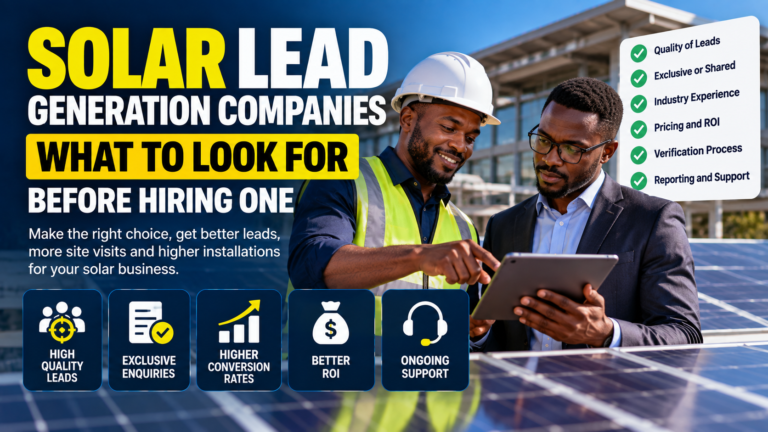
Use the same questions for every vendor so that you are comparing equivalent offers. For a deeper checklist, see our guide to solar lead generation companies.
- What exactly am I buying? Request a written definition of a lead, qualified lead, appointment, and completed appointment.
- Is it exclusive? Ask how many installers receive the enquiry and what exclusivity means in the contract.
- How is the lead verified? Ask what checks are performed and whether consent records are available.
- How fresh is the data? Request the time between submission and delivery.
- What is the replacement policy? Clarify duplicate, invalid, out-of-area, and non-consenting records.
- What does the price include? Separate media spend, management, creative, landing pages, CRM, taxes, and other fees.
- Who owns the assets? Confirm ownership and access to ad accounts, tracking, landing pages, and lead data.
- How is success measured? Agree on reporting, attribution windows, and the difference between a lead, sale, and completed installation.
- Can you show relevant evidence? Ask for anonymised case studies from similar markets and business models, including both volume and downstream conversion.
- What happens if we stop? Understand notice periods, data access, account handover, and any outstanding commitments.
Be cautious of guaranteed sales claims that do not account for your pricing, service area, financing options, sales capacity, and installation operations.
Should you buy leads or generate your own?
Buying leads can provide a faster way to test demand or supplement a sales team. It may be useful when you have available capacity and need opportunities while building your own marketing channels. However, you depend on the provider’s targeting, consent practices, supply, and pricing.
Generating your own leads through search, social media, educational content, referral systems, and local partnerships takes time and requires ongoing work. In return, you can build brand recognition, learn directly from prospects, and retain more control over the customer journey and marketing assets. Start with our guides on how to get more solar installation leads and ways to generate solar leads without buying them.
Many installers use a blended approach. They test purchased leads with a capped budget while investing in owned assets such as a website, useful content, customer reviews, referral requests, and a well-managed CRM. Compare channels using cost per completed installation and customer lifetime value where relevant.
How solar installers can control acquisition costs
- Define your ideal customer and service area before launching campaigns.
- Use a clear offer that attracts prospects who can realistically buy.
- Make the landing page explain the next step, not just collect a phone number.
- Ask enough qualifying questions to filter poor-fit enquiries without making the form unnecessarily difficult.
- Route new leads to a named owner and establish a follow-up standard.
- Use a CRM to record calls, appointments, site visits, proposals, and outcomes.
- Review lost deals to identify recurring objections, pricing issues, or service-area mismatches.
- Test one major campaign variable at a time where practical.
- Keep an eye on installation capacity so you do not pay to generate demand you cannot serve.
- Reconcile marketing reports with actual signed contracts and completed installations.
The goal is not to make every lead cheaper. It is to build a predictable system that acquires suitable customers at a cost your margins can support.
Frequently asked questions
Is solar lead generation expensive?
It depends on the market, lead type, qualification level, and business model. A low-priced shared contact and a verified exclusive appointment are not comparable products. Evaluate total acquisition cost and profit rather than relying on the advertised cost per lead.
How many solar leads do I need to make one sale?
Use your own measured conversion rate. If 4% of leads become customers, the mathematical average is 25 leads per customer. That is a planning estimate, not a guarantee that every batch of 25 will produce a sale. Track results over time and separate lead sources.
Are exclusive solar leads worth the higher price?
They may be, if the improvement in conversion and sales efficiency offsets the higher price. Compare cost per completed installation using your own close rates. Do not assume the word “exclusive” guarantees quality; verify the provider’s definition and terms.
Should I pay for leads or pay a marketing agency?
Lead purchasing is one way to source enquiries. An agency may manage a broader system that includes strategy, advertising, landing pages, tracking, and optimisation. Compare scope, ownership, reporting, and total cost. The right arrangement depends on your internal capabilities and growth goals.
What is a good return on investment for solar marketing?
There is no single ROI target that applies to every installer. Margins, sales cycles, financing, cancellations, overhead, and cash flow differ. Set a target based on your contribution margin and business requirements, then measure completed installations rather than relying only on early-stage leads.
Can I use US solar lead prices to budget in Nigeria?
Use them only as context. Advertising costs, household purchasing power, energy spending, payment structures, competition, and sales processes differ by market. For Nigeria, request local quotes and run a controlled pilot to establish your own cost per qualified lead, site visit, and completed installation.
Final thoughts
Solar lead generation costs should be judged by what they produce for your business. A low cost per lead can hide poor contact rates, intense competition, and wasted sales time. A higher-priced lead can still be a poor investment if it does not convert or if the project margin cannot support the acquisition cost.
Before committing to a provider, define the deliverable, confirm lead ownership and verification, calculate your allowable acquisition cost, and track every stage from enquiry to completed installation. Start with a measured pilot, review the data, and scale only when the economics make sense.
Need a more predictable pipeline of solar enquiries? Rensol Marketing helps solar businesses plan and improve their customer acquisition systems, from campaign strategy and landing pages to lead tracking and follow-up. Visit Rensol Marketing to explore how a tailored approach could fit your business.
Sources and further reading
- Service Hero Marketing: How much do solar leads cost in 2026?
- ROI Performance: How Much Do Solar Leads Cost in 2026?
- Solcertain: Solar Leads Pricing
- What Solar Costs: What a solar lead costs and what one is worth
- LeadsHQ: How Much Should Solar Leads Cost in 2026?
Pricing examples are based on publicly available provider content reviewed in October 2026. They are not audited market-wide averages. Confirm current terms and obtain local quotes before making budget decisions.
Quick solar lead generation cost checklist
- List every cost that makes up your solar lead generation cost: media, fees, software and sales time.
- Calculate cost per acquired customer, because solar lead generation cost per lead can mislead.
- Work backwards from your target acquisition cost to find the most your solar lead generation cost can reach per lead.
- Separate shared, exclusive, appointment and campaign pricing before you compare quotes.
- Track every funnel stage so you can see where solar lead generation cost is wasted.
- Recalculate your allowable lead price whenever your close rate changes.
- Run a capped pilot before you commit to a large solar lead generation cost.
There is no single correct solar lead generation cost. The right figure is the one your margins can support. Review your solar lead generation cost quarterly and adjust as your conversion data improves.
Ask each provider to show the full solar lead generation cost, including setup and management fees.
Use your own funnel data, not US benchmarks, to judge your solar lead generation cost in Nigeria.
Keep a simple record of solar lead generation cost by channel so you can spot changes early.
Related reading
More guidance related to solar lead generation cost:




Want the Solar Lead Generation ROI Calculator? Ask for it in a strategy conversation with Rensol Marketing. You can also read more on our blog.