A solar installation business can attract website visitors, receive enquiries, and still struggle to close enough customers. The problem is often not a lack of interest. It is the absence of a clear process that moves a prospect from curiosity to a confident buying decision.
A solar sales funnel gives every stage of that journey a purpose. It helps you attract the right audience, capture enquiries, understand their needs, book consultations, prepare suitable proposals, follow up consistently, and turn qualified opportunities into installations.
Solar is a considered purchase. Homeowners and business owners may need to compare system sizes, understand batteries and inverters, evaluate financing, consult other decision-makers, and trust an installer before committing. Your funnel must therefore do more than collect phone numbers. It must build confidence and make the next step easy.
This guide explains how to create a practical solar sales funnel, what each stage should accomplish, which tools to use, and how to measure performance. For the traffic side of the picture, read our guide on how to get more solar installation leads, and see this overview of sales funnel fundamentals.
Want a funnel built around your business? Request a strategy conversation with Rensol Marketing to map your visitor-to-customer journey.
Quick answer: In short, a solar sales funnel gives every stage of the buyer journey a purpose: attract, capture, qualify, consult, propose, follow up and close. A clear solar sales funnel also shows you which stage is losing opportunities.
Key takeaways
- A solar sales funnel gives every stage of the buyer journey a purpose: attract, capture, qualify, consult, propose, follow up and close.
- Start with one audience, one offer and one landing page, then connect them to a CRM with clear stages and next actions.
- Measure each stage of the solar sales funnel to find the bottleneck, and fix the weakest stage first.
Table of Contents
What Is a Solar Sales Funnel?
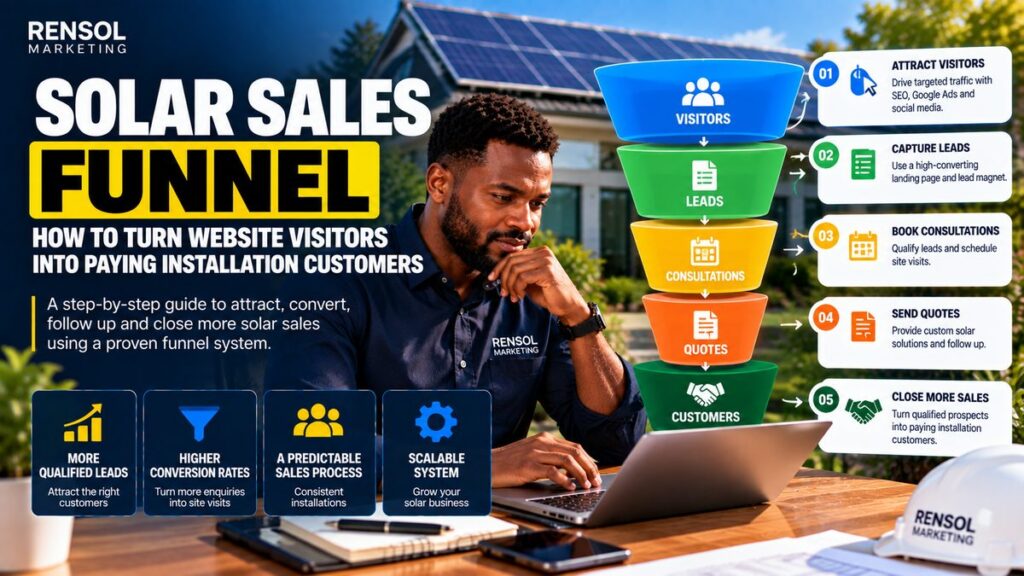
A sales funnel is a structured process that guides potential customers from their first interaction with your business to a purchase and, ideally, a long-term customer relationship.
A simple solar funnel has five stages:
- Attract: Bring relevant visitors to your website, landing page, or social media content.
- Capture: Convert interested visitors into identifiable leads by offering a useful next step.
- Qualify and consult: Understand the customer’s energy needs, budget, property, timeline, and decision process.
- Propose and follow up: Present a suitable solution, explain the value, address concerns, and stay in touch.
- Close and retain: Confirm the project, deliver a smooth installation experience, and create opportunities for referrals, maintenance, and future work.
The funnel is not always linear. Some people will return to an earlier stage, pause for months, or contact you after seeing several pieces of content. Build a system that can accommodate those journeys instead of assuming every lead will buy immediately.
Why Solar Installers Need a Defined Funnel
It connects marketing to sales
Without a shared process, marketing may celebrate a high number of enquiries while sales complains that the leads are weak. A funnel creates common definitions. Both teams can see how many leads become qualified opportunities, consultations, proposals, and customers. It also makes clear whether you are paying for exclusive solar leads or shared ones.
It reduces lost opportunities
Many prospects do not buy during the first conversation. They may need to discuss the investment with a spouse, obtain internal approval, compare options, or wait for funds. A funnel assigns a next action and follow-up date so interested people are not forgotten.
It creates a better buying experience
Customers often feel uncertain about system sizing, product quality, warranties, installation, and expected performance. A well-designed funnel answers questions in the right order and gives prospects confidence that your company understands their situation.
It helps you identify bottlenecks
If you attract many visitors but receive few enquiries, your offer or landing page may need work. If you get enquiries but few consultations, the issue may be response time, qualification, or booking friction. If proposals are not converting, examine pricing, proposal clarity, trust, and follow-up.
Stage 1: Attract the Right Visitors
The purpose of traffic generation is not to attract everyone interested in renewable energy. It is to reach people who have a problem your business can solve and are located in areas you can serve.
Search engine optimisation
Create useful pages that answer the questions your target customers search for. Examples include:
- Solar installation for homes in your service area
- Solar systems for offices, shops, and factories
- How to choose an inverter and battery
- Solar installation cost factors
- Solar backup for refrigeration or essential equipment
- Questions to ask before hiring a solar installer
Use location-specific pages only when they provide real value and reflect areas you serve. Avoid publishing near-identical pages that simply swap city names.
Google Ads
Search advertising can help you reach people actively looking for solar solutions. Separate campaigns by intent, such as residential installation, commercial solar, battery backup, or a specific service area. Google Ads Help is the official reference for setting up conversion tracking.
Send each ad to a landing page that matches the search. A person searching for commercial solar should not land on a generic page focused only on household packages.
Track calls, forms, and booked consultations as separate conversions where possible. A click or form submission is an early signal, not proof of a sale.
Facebook and Instagram advertising
Social ads can introduce your business to homeowners and business decision-makers who may not be searching yet. Use creative that speaks to a specific problem, such as reducing generator dependence, maintaining critical operations, or planning a new property. Meta Business explains campaign formats and measurement.
A clear offer can make the ad more useful. Examples include a preliminary energy assessment, a solar system suitability consultation, or a guide to planning backup power. Make sure the offer is something your team can deliver reliably.
Referral and partner channels
Electricians, builders, architects, property managers, facility managers, and real estate professionals may encounter people who need solar. Build relationships with relevant partners and give them a simple way to refer enquiries. Be transparent about referral arrangements and ensure they comply with applicable rules.
Educational content
Publish articles, short videos, case studies, and answers to common questions. Helpful content reduces uncertainty and gives prospects something valuable to review before a sales call. We list more content and channel ideas in our guide to ways to generate solar leads without buying them.
Stage 2: Capture Leads With a Relevant Offer
Once a visitor arrives, give them a clear reason to take action. A generic “Contact us” button can work, but a specific offer often communicates more value.
Possible solar lead offers include:
- Request a solar suitability assessment
- Book a consultation with a solar specialist
- Get a preliminary system recommendation
- Download a home solar planning checklist
- Request a commercial energy review
- Compare backup options for essential appliances
Only promise assessments, savings estimates, or response times that your business can support. If a final system design requires a site visit or engineering review, describe the initial offer as preliminary.
Build a focused landing page
A landing page should answer five questions quickly:
- What service are you offering?
- Who is it for?
- What problem does it address?
- Why should the visitor trust your company?
- What should the visitor do next?
A useful page structure is:
- Headline focused on the customer’s outcome
- Short explanation of the offer
- Relevant benefits and use cases
- Proof such as genuine project photos, testimonials, certifications, or case studies
- A short form or booking option
- Answers to common objections
- A clear privacy statement and contact details
Remove unnecessary navigation if it distracts from the main action, but keep essential information accessible. Test the page on mobile because many visitors will arrive from social platforms or messaging apps.
Ask for enough information, not everything
A long form can discourage people from enquiring. Start with essential details and collect deeper technical information during discovery.
A basic form might request:
- Name
- Phone number or email
- Location
- Home or business
- Main reason for considering solar
- Preferred contact method
For commercial enquiries, you may also ask for the business name and broad project type. Avoid asking for sensitive financial information unless it is genuinely required and handled securely.
Stage 3: Respond and Qualify
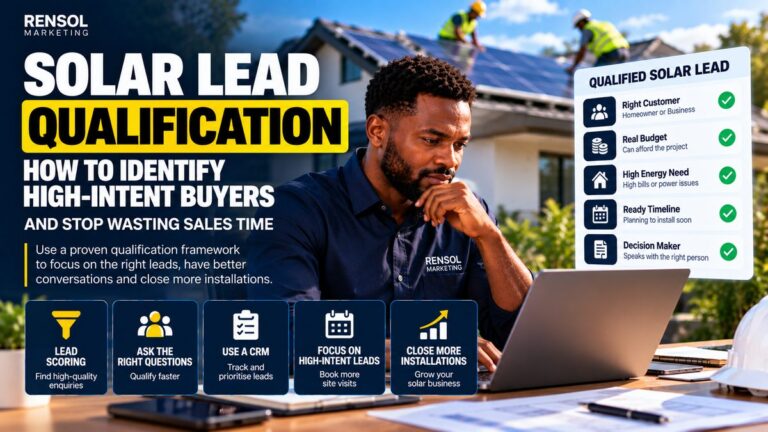
A lead is not yet a sales opportunity. Your next task is to understand whether the prospect’s needs match your service and agree on an appropriate next step. Our guide to solar lead qualification gives you the full question list and a scoring model.
Make the first response personal
A good first message acknowledges the request and explains what happens next. For example:
“Hi [Name], thanks for requesting information about solar for your property in [Location]. I can help you understand which options may suit your needs. Could I ask a few quick questions about what you want to power and when you hope to install?”
Avoid sending an immediate price list without context if the system requirements are not yet known.
Use a consistent discovery framework
Ask about:
- Need: What problem is the customer trying to solve?
- Load: Which appliances, equipment, or operations need power?
- Usage: How many hours of backup are required, and at what time?
- Current cost: What does the customer spend on electricity or fuel?
- Property: Where will the system be installed, and who controls the property?
- Budget: Is there a budget, financing preference, or phased approach?
- Authority: Who will review and approve the purchase?
- Timeline: When does the customer want to proceed?
- Concerns: What questions or risks could prevent a decision?
Use the answers to determine whether the prospect needs a quick consultation, a technical assessment, a longer nurture sequence, or a referral to another service.
Offer a clear next step
Do not end a useful conversation with “Let us know if you need anything.” Suggest a concrete action: book a call, share an electricity bill, complete a load checklist, arrange a site visit, or include another decision-maker in the discussion.
Stage 4: Book Consultations and Site Visits
A consultation should help the customer understand their options and help your team determine the right solution. It should not be a generic sales pitch.
Make booking easy
Offer a small number of appointment options or use a booking calendar. Confirm the time, expected duration, meeting format, and any information the customer should prepare.
Send a reminder before the appointment and make rescheduling simple. If the prospect misses the call, follow up politely and offer another time rather than treating one missed appointment as a rejection.
Prepare before the meeting
Review the lead’s form, previous messages, location, stated needs, and any documents they have shared. If the meeting is with a business, identify the relevant operational context and likely stakeholders.
Structure the consultation
A practical agenda could be:
- Confirm the customer’s goals.
- Review their current power situation.
- Clarify essential and non-essential loads.
- Discuss possible system configurations.
- Explain what requires technical verification.
- Review budget and payment considerations.
- Agree on the next step and timeline.
For projects that require a site visit, explain what the team will inspect and what the customer will receive afterward.
Stage 5: Present a Proposal That Helps the Customer Decide
A proposal should make the recommendation understandable, not simply list equipment and a total price.
Include the following where relevant:
- Customer goals and project assumptions
- Recommended system configuration
- Equipment specifications and quantities
- What the system is designed to support
- Important limitations and assumptions
- Installation scope and exclusions
- Warranty and after-sales information
- Price and payment terms
- Financing details, if available and confirmed
- Project timeline and dependencies
- Validity period and next steps
Explain why the proposed system fits the customer’s needs. If there are multiple options, present them in a way that makes the trade-offs clear, such as upfront investment, backup duration, capacity, and expandability.
Do not guarantee bill reductions, payback periods, or uninterrupted power unless the claim is supported by a transparent assessment and the relevant conditions are stated.
Present the proposal live when possible
A short walkthrough gives the customer a chance to ask questions and helps you understand what matters most. If the proposal is sent by email or WhatsApp, arrange a specific time to review it rather than waiting indefinitely for a response.
Stage 6: Follow Up With Purpose
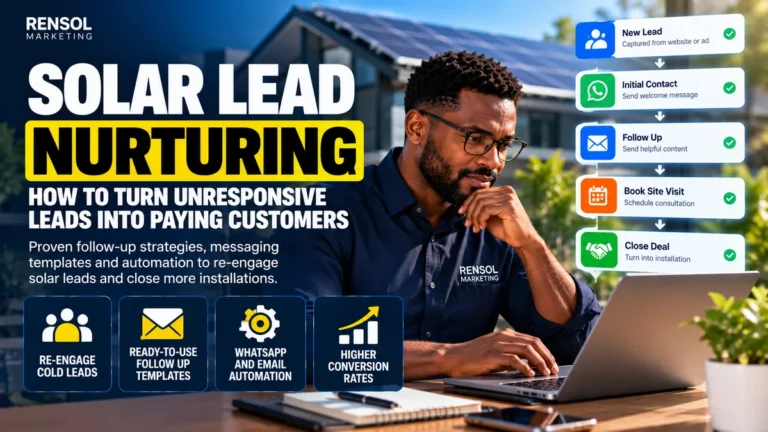
Follow-up is part of the sales process, not an afterthought. Prospects may be busy or uncertain, and a helpful reminder can bring the decision back into focus. Prospects who go quiet belong in a structured solar lead nurturing sequence.
Use a cadence that respects the customer’s preferences and applicable messaging rules. For example:
- After the proposal: Confirm receipt and offer to clarify anything.
- A few days later: Ask whether the customer has questions about the recommended system.
- After a week: Share a relevant case study, FAQ, or explanation of a concern they raised.
- Later: Check whether their timeline or requirements have changed.
- Longer-term: Send occasional useful updates if they have agreed to receive them.
The timing should be adapted to the customer’s stated decision date and project urgency. Do not keep sending messages when someone has opted out or asked you to stop.
Use objection-led follow-up
Instead of asking “Are you ready to buy?” every time, address the specific issue holding the prospect back.
If the concern is price, clarify what is included and whether there are suitable alternatives. If the concern is trust, share verifiable project examples, references, credentials, or warranty information. If the customer needs approval, offer a concise summary they can share with the decision-maker.
Stage 7: Close the Sale and Create a Smooth Handover
When the customer agrees, confirm the scope, payment terms, responsibilities, schedule, and any remaining dependencies in writing. Make sure the sales team hands over accurate discovery notes to the technical and installation teams.
A smooth handover matters because the customer’s experience after payment influences reviews, referrals, and future service opportunities.
After installation:
- Confirm the customer understands system operation and safety guidance.
- Provide relevant manuals and warranty documents.
- Explain the support process.
- Schedule any agreed maintenance or check-in.
- Request feedback at an appropriate time.
- Ask for a review or referral when the customer is satisfied.
The funnel should not end at the invoice. A satisfied customer may become a source of repeat work, referrals, or a case study, subject to their permission.
The Solar Funnel Metrics to Monitor
Track performance at each stage so you can find where opportunities are being lost.
| Metric | What it tells you |
|---|---|
| Relevant website sessions | Whether your traffic is reaching the intended audience |
| Landing-page conversion rate | How effectively a page turns visitors into enquiries |
| Cost per lead | How much marketing spend produces an enquiry |
| Contact rate | Whether your team reaches the people who enquire |
| Qualification rate | How many enquiries match your opportunity criteria |
| Consultation booking rate | Whether qualified leads agree to a meeting or assessment |
| Show rate | How many booked appointments take place |
| Proposal rate | How many qualified opportunities receive a proposal |
| Proposal-to-sale rate | How effectively proposals convert |
| Cost per acquired customer | The marketing and sales cost of winning a customer |
| Average sales cycle | How long opportunities take to close |
| Revenue by source | Which channels contribute to actual sales |
Define each metric consistently. For example, decide whether “lead” means every form submission or only a unique, valid enquiry. Use the same definitions when comparing campaigns and months.
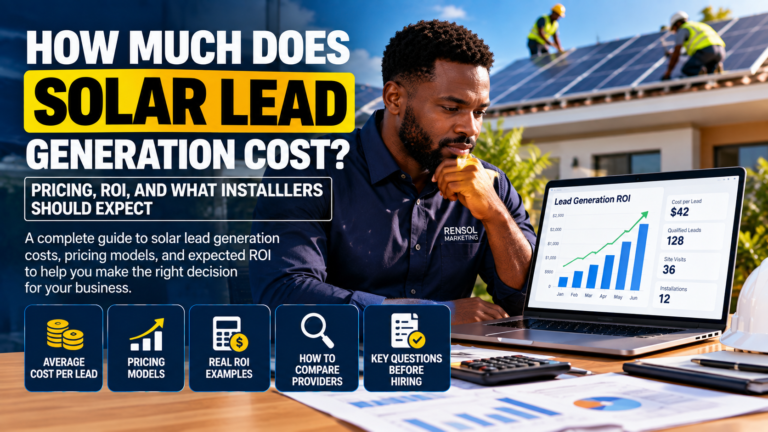
Do not optimise only for cheap leads. A campaign with a higher cost per enquiry may still contribute more profitable projects if it attracts better-fit customers and converts at a higher rate. See our guides to solar lead generation costs and ROI and solar lead generation companies for how to judge sources by customers won.
A Simple Solar Sales Funnel Automation
Automation can help your team respond consistently, but it should support human conversations rather than replace technical judgement.
A basic workflow might look like this:
- A visitor submits a form or requests a consultation.
- The CRM creates a lead record and stores the source.
- The prospect receives a confirmation message that matches their chosen channel and consent.
- A salesperson is assigned a task to make contact.
- The prospect answers initial qualification questions.
- Qualified leads receive a booking link or are contacted to schedule a call.
- Appointment reminders are sent.
- After the consultation, the CRM records the outcome and next action.
- Proposal delivery triggers a follow-up task.
- Won opportunities move to installation handover, while suitable non-ready leads enter nurture.
Use approved messaging templates and follow the rules of each channel. Provide a clear way for people to manage their communication preferences. Review automation logs regularly so errors do not silently interrupt the customer journey.
Common Solar Funnel Mistakes
Sending all traffic to the homepage
A homepage serves many purposes. A campaign-specific landing page can communicate a more relevant offer and make the next action clearer.
Asking for too much information upfront
Collect what is needed to start a conversation. Gather detailed load and technical information after the prospect understands why it matters.
Failing to respond consistently
If some leads receive a call while others wait several days, the experience becomes unpredictable. Assign ownership and monitor first-response time.
Treating a quote as the end of the process
A proposal is a step in the buying journey. Plan a review and follow-up before sending it.
Using the same message for every lead
A homeowner, factory manager, and property developer have different needs. Segment your funnel by customer type, intent, and project complexity. For business buyers, our guide to commercial solar lead generation covers account research and buying committees.
Ignoring lost opportunities
Record why a deal was lost or delayed. Review these reasons to improve targeting, messaging, pricing explanations, and sales enablement.
Measuring activity instead of outcomes
Impressions, clicks, and message volume can be useful diagnostic metrics, but they do not replace qualified opportunities, completed installations, revenue, and customer satisfaction.
Want a worksheet to map your funnel? Ask for our Solar Sales Funnel Builder Checklist in a strategy conversation with Rensol Marketing.
A 30-Day Plan to Build Your Funnel
Week 1: Map the customer journey. Write down every step from first click to installation. Define funnel stages, owners, and the information required to move a lead forward.
Week 2: Build the conversion assets. Create or improve one campaign landing page, a short enquiry form, a consultation booking process, and a proposal template. Ensure all links and forms work on mobile.
Week 3: Connect the CRM and follow-up. Set up lead source tracking, status definitions, task reminders, appointment confirmations, and proposal follow-up tasks. Test the workflow with sample enquiries.
Week 4: Review performance. Examine where leads are dropping out. Speak with salespeople about common objections and customer questions. Improve the weakest stage first, then continue testing.
Start with one audience and one offer. Once the process works reliably, expand it to additional services, locations, and customer segments. It fits into wider solar marketing strategies for installers.
Frequently Asked Questions
How many stages should a solar sales funnel have?
There is no single required number. A useful starting point is attract, capture, qualify, consult, propose, follow up, and close. Your CRM may combine or split stages depending on how your team works.
Do solar installers need a landing page?
A dedicated landing page is useful when you run a specific campaign or promote a focused offer. It allows you to match the message to the visitor’s intent and measure conversions more clearly. A well-organised service page can also work if it has a clear call to action.
What is the most important part of a solar sales funnel?
Every stage contributes to the outcome. The most important improvement depends on your current bottleneck. If visitors do not enquire, improve the offer and page. If enquiries do not become consultations, examine response, qualification, and booking. If proposals do not close, review fit, trust, clarity, pricing, and follow-up.
Should I automate solar sales follow-up?
Automate routine tasks such as confirmations, reminders, lead assignment, and follow-up prompts. Keep human involvement for technical recommendations, complex objections, negotiation, and customer decisions. Respect consent and communication preferences.
How can I tell whether my funnel is profitable?
Track marketing and sales costs alongside customers won, revenue, gross margin, and the time required to close. Compare performance by lead source and customer segment. Include the cost of site visits, proposal preparation, and other sales activities where possible.
How long does it take to build a solar sales funnel?
A basic funnel can be mapped and launched in stages. The timeline depends on whether you already have a website, CRM, landing page, and sales process. Begin with the essentials, test the journey, and improve it using actual conversion data.
Build a More Predictable Solar Sales Process
A solar sales funnel turns scattered marketing and follow-up activities into a system your team can understand, measure, and improve. It helps you attract relevant prospects, make it easy to enquire, qualify needs, present suitable solutions, and stay engaged until the customer is ready to decide.
You do not need a complicated technology stack to begin. Start with one clear offer, one focused landing page, a consistent discovery process, a CRM with defined stages, and a reliable next action for every active lead.
Want to generate and convert more solar enquiries? Rensol Marketing helps solar companies improve lead generation, follow-up, and conversion systems. Visit Rensol Marketing to explore how a structured marketing and sales process can support your growth.
Quick solar sales funnel checklist
- Start with one audience, one offer and one landing page for your solar sales funnel.
- Connect the form to a CRM with clear stages and next actions.
- Respond to every enquiry with the same standard of speed and care.
- Book consultations with a calendar link, not a back-and-forth of messages.
- Review every stage of the solar sales funnel monthly and fix the weakest one first.
- Use your solar sales funnel data to decide where to spend your next naira.
A solar sales funnel does not need complicated software. It needs clear stages, owners and honest numbers. Build the simplest solar sales funnel your team will actually use, then improve it.
Draw your solar sales funnel on one page so the whole team can see the stages.
Related reading
More guidance related to solar sales funnel:

Ready to convert more solar enquiries? Request a strategy conversation with Rensol Marketing to review your lead generation, follow-up and conversion system. Read more on our blog.