Solar installers do not need more marketing activity for its own sake. They need a reliable way to reach suitable customers, earn their trust, turn enquiries into site visits, and convert proposals into completed installations.
That requires more than running a few adverts or posting panel photos on social media. Solar is a considered purchase. Prospects may need to understand system sizing, battery backup, installation requirements, financing, warranties, and the expected savings before they feel ready to speak with a salesperson. The marketing system must answer those questions at every stage.
This guide explains practical solar marketing strategies for residential and commercial installers. It covers positioning, local search, content, paid advertising, referrals, social media, landing pages, follow-up, and measurement. It also explains how to combine channels without wasting budget.
The examples apply across markets, but costs, regulations, electricity tariffs, incentives, and buyer behaviour differ by country. Use local data and customer conversations to adapt each strategy.
Want a marketing system built around your business? Request a strategy conversation with Rensol Marketing to review your customer acquisition process.
Quick answer: In short, the best solar marketing strategies combine clear positioning, a website that converts, local visibility, useful content, paid ads, referrals and fast follow-up. Test one channel at a time and judge solar marketing strategies by completed installations.
Key takeaways
- Effective solar marketing strategies combine positioning, a converting website, local SEO, content, ads, referrals and follow-up.
- Start with the basics and test one channel at a time.
- Judge your solar marketing strategies by completed installations, not clicks.
Table of Contents
1. Start with a clear market position
Before choosing channels, decide exactly whom your business serves and why a customer should choose you.
A solar company that markets to everyone often ends up with generic messaging. A clearer position helps prospects recognise that your service fits their needs.
Consider segmenting your audience by:
- Customer type: homeowners, small businesses, factories, schools, hospitals, farms, or property developers.
- Energy problem: high electricity bills, unreliable grid supply, generator fuel costs, outages, or the need for backup power.
- Project size: small backup systems, whole-home systems, commercial installations, or multi-site projects.
- Buying readiness: researching options, comparing quotes, seeking financing, or ready for a site assessment.
- Geography: the specific towns, states, or service areas your team can reliably support.
A residential homeowner and a factory manager may both want solar, but they need different messages. A homeowner may care about comfort, backup power, and household budget. A commercial buyer may need a load analysis, payback assumptions, maintenance plan, and a clear business case.
Write a one-sentence positioning statement:
“We help [specific customer] solve [specific energy problem] with [your approach], supported by [credible proof or service advantage].”
Avoid unsupported claims such as guaranteed savings or “free electricity.” Use real project evidence and state the assumptions behind any financial estimate.
2. Build a website that converts, not just one that looks good
Your website is often where prospects verify your company after seeing an advert, receiving a referral, or finding you in search results. It should answer their questions and make the next step obvious.
At minimum, create:
- A homepage that states who you serve, what you install, and where you operate.
- Separate pages for residential, commercial, and other major service lines.
- A process page explaining consultation, site assessment, design, quotation, installation, and aftercare.
- Project or case-study pages with real photos and measurable details.
- A frequently asked questions section covering pricing, batteries, warranties, maintenance, and installation timelines.
- Contact options that work well on mobile, including a short enquiry form and a clear phone or messaging option.
- Privacy information explaining how submitted details will be used.
Make the primary call to action specific. “Request a site assessment” or “Get a custom system recommendation” tells a visitor what will happen next. A vague “Submit” button does not.
Keep forms short enough to complete on a phone. Ask only for information needed to respond or qualify the enquiry. You can gather additional details during the first conversation.
Test page speed, mobile usability, form delivery, and confirmation messages. A beautiful page that fails to send enquiries is not a marketing asset.

3. Improve local SEO and your business profile
Local search helps people discover installers when they search for a service in a particular area. Your business profile and website should reinforce each other with accurate, consistent information.
Start by claiming and completing your Google Business Profile where the service is available. Use the correct business name, categories, phone number, website, service area, opening hours, and description. Upload genuine photographs of your team, completed installations, equipment, and service vehicles.
Keep the profile active by:
- Adding new project photos regularly.
- Responding professionally to reviews, including critical feedback.
- Answering common customer questions.
- Updating hours and service details when they change.
- Sharing useful updates rather than repeatedly posting generic sales messages.
On your website, create useful location pages only for places you genuinely serve. Each page should contain distinct information, such as local project examples, service coverage, common customer needs, and relevant contact details. Avoid creating dozens of near-identical pages that simply swap city names.
Ask satisfied customers for honest reviews after a successful project. Make the request easy, but do not buy reviews, pressure customers, or offer incentives in ways that violate platform policies. Reviews are most useful when they describe the customer’s actual experience.
4. Publish content that answers buying questions
Solar content marketing works when it helps people make a decision. Instead of publishing articles only because a keyword tool suggests them, build content around the questions your sales team hears repeatedly.
Useful topics include:
- How to estimate the right solar system size for a home or business.
- What affects the cost of a solar installation?
- How batteries change backup time and system design.
- Solar versus generator costs over a realistic period.
- What happens during a professional site assessment?
- How to compare two solar quotations.
- What maintenance does a solar system need?
- What warranties cover, and what they do not cover.
- How to prepare a business for a commercial energy audit.
- Common reasons a proposed system may not meet a customer’s expectations.
Use real examples where possible. Explain assumptions, show calculations, and identify situations where results vary. A practical guide with original insight is more valuable than a generic article that repeats basic definitions.
Connect each article to a relevant service page and a next step. For example, a guide about system sizing can invite readers to request a site assessment. This turns educational traffic into a useful pathway rather than leaving visitors at the end of an article.
Repurpose one strong article into a short video, carousel, email, and sales-team FAQ. This helps maintain consistency without inventing a new topic for every channel. For more ideas, read our guide to ways to generate solar leads without buying them.
5. Use Google Ads to capture active demand
Search advertising can reach people already looking for solar installation, battery backup, or a commercial energy solution. It can also become expensive if campaigns target broad or irrelevant searches. For the wider picture, see our guide on how to get more solar installation leads.
Build campaigns around clear intent groups, such as:
- Solar installation in a specific service area.
- Commercial solar installation.
- Solar battery or backup power systems.
- Solar system assessment or quotation.
- Solar for a particular type of business.
Send each ad to a landing page that matches the search. Someone searching for commercial solar should not land on a page written only for homeowners.
Use negative keywords to filter irrelevant searches, and review actual search terms regularly. Track meaningful actions such as qualified enquiries, calls, booked assessments, and completed projects rather than optimising only for clicks.
Set a budget your business can afford to test. Do not assume early results represent long-term performance. Review lead quality and sales outcomes before increasing spend. Our guide to solar lead generation costs and ROI shows how to work out what you can afford per lead.
6. Use Facebook and Instagram to educate and create demand
Social advertising can introduce your business to people who are not actively searching yet. It is useful for demonstrating projects, explaining common energy problems, and inviting prospects to take a low-friction next step.
Creative ideas include:
- A short walkthrough of a completed installation.
- A technician explaining how battery backup works.
- A customer story describing the problem solved.
- A simple comparison of generator operating costs and a solar option, using transparent assumptions.
- A behind-the-scenes video showing safety, workmanship, and testing.
- A short educational video answering one common question.
Keep the message focused. One advert should communicate one main benefit and one action. Avoid stuffing every service, product, and claim into a single creative.
Lead forms can reduce friction, but they may also produce people who are casually interested rather than ready to buy. Use a confirmation message and follow-up process that checks fit and readiness. If the campaign sends visitors to a landing page, make sure the page loads quickly and repeats the offer from the advert.
Test different hooks, formats, audiences, and offers systematically. Change one major variable at a time when possible so you can learn what influenced the result.
7. Create a compelling offer
“Contact us for solar” is a weak offer because it asks the prospect to take action without explaining the value.
A useful offer reduces uncertainty and gives the customer a reason to start a conversation. Depending on your capabilities, you might offer:
- A preliminary energy assessment.
- A custom system recommendation.
- A site evaluation.
- A review of an existing quotation.
- A commercial energy-cost analysis.
- A consultation about backup requirements.
- A comparison of system options at different budgets.
Be clear about what is included, what information the customer needs to provide, and whether the service is free or paid. Do not advertise a free audit if it is actually a sales call with no meaningful analysis.
A strong offer is specific, credible, and easy to understand. It should attract the type of customer your business can serve profitably.
8. Turn completed installations into referral opportunities
Satisfied customers can introduce your business to people who already trust them. But referrals rarely grow consistently when the only process is telling customers, “Please recommend us.”
Create a simple referral system:
- Decide what qualifies as a referral and when any reward is earned.
- Ask for introductions after the customer has experienced the completed project and support process.
- Provide a shareable message or referral link.
- Record the referrer and referred prospect in your CRM.
- Thank customers who make introductions, whether or not the referral buys.
- Review referral activity and outcomes regularly.
If you offer a reward, state the terms clearly and comply with local laws and platform rules. A reward should not encourage misleading reviews or undisclosed endorsements.
Also turn customer permission into case studies. Capture the original problem, the solution installed, the project timeline, and the customer’s feedback. Obtain consent before publishing names, images, bills, or other identifying information.
9. Use partnerships to reach customers through trusted channels
Partnerships can create opportunities that paid advertising alone may not reach. Potential partners vary by market and customer segment.
For residential solar, consider relationships with property developers, real estate professionals, electricians, architects, and home-improvement businesses. For commercial projects, potential partners may include facility managers, energy consultants, engineering firms, equipment suppliers, and business associations.
A partnership should provide value to both sides. Offer useful educational material, a clear referral process, and responsive communication. Avoid informal arrangements that create confusion about who owns the customer relationship or how commissions work.
Start with a small number of relevant partners. Track introductions, qualified opportunities, and completed projects to understand whether the relationship is worth expanding.
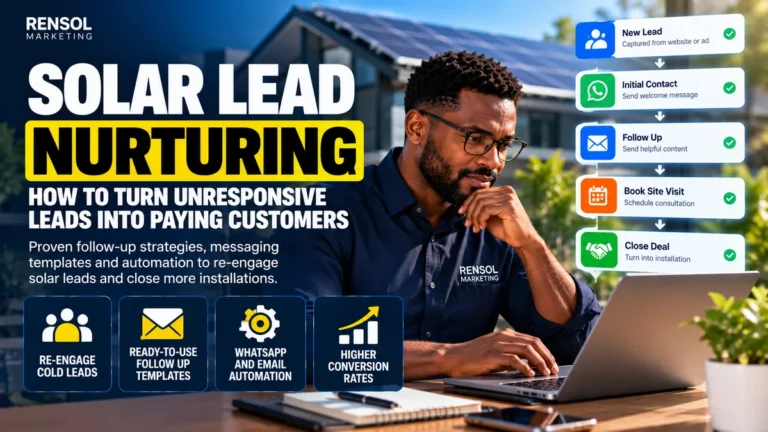
10. Build a follow-up system for every enquiry
Many prospects do not buy immediately. They may be comparing quotations, waiting for funds, discussing the project with family or management, or planning around a future move or expansion.
A follow-up system helps your company remain useful without becoming intrusive.
A practical process might include:
- Immediately: confirm receipt and explain the next step.
- Within one business day: make a personal contact attempt and ask key qualifying questions.
- After the first conversation: send relevant information or schedule the site assessment.
- After the assessment: deliver the proposal when promised and explain how to review it.
- After the proposal: follow up to answer questions, understand concerns, and agree on a next action.
- Longer term: with appropriate consent, send occasional educational updates to prospects who are not ready yet.
Use the customer’s preferred channel and respect opt-outs. Do not send repetitive messages simply because an automation is scheduled.
A CRM should record the source, status, last contact, next action, owner, and outcome. If a lead is not followed up, the system should make that visible.
11. Use WhatsApp and email as service channels, not just broadcast tools
Messaging can make it easier for prospects to ask questions and share documents, especially in markets where WhatsApp is widely used. Email is useful for longer explanations, proposals, and educational follow-up.
Set expectations. Tell customers when they can expect a reply and what information is safe to send. Use approved templates and consent-based messaging where required by the platform and local regulations.
Personalise messages with context from the enquiry. A customer who asked about battery backup should receive information about backup requirements, not a generic message about an unrelated product.
Automations can acknowledge enquiries, assign leads, remind staff about tasks, and send agreed follow-ups. Keep a human available for complex technical questions, complaints, and purchasing decisions. Automation should support a helpful conversation, not create the impression that a customer is being ignored.
12. Make your sales proposal part of your marketing
A proposal is more than a price sheet. It is an opportunity to demonstrate professionalism and help the customer make a confident comparison.
A clear proposal should explain:
- The customer’s stated energy needs and project goals.
- The assumptions used in the assessment.
- The recommended system and major components.
- Expected performance, with appropriate caveats.
- What is included and excluded from the price.
- Installation steps and estimated timeline.
- Warranty and maintenance terms.
- Payment or financing options, if available.
- The next step and how to ask questions.
Avoid presenting estimated savings as guaranteed outcomes. Explain the factors that could affect performance, such as usage patterns, weather, tariffs, system configuration, and maintenance.
Follow up after sending the proposal. Ask whether the customer has questions and whether they are comparing other options. This gives your team a chance to clarify value rather than simply asking, “Have you decided?”
13. Use video to make technical information easier to understand
Solar is visual, and video can show details that are difficult to communicate in a short text post. You do not need a studio to begin.
Record short, clear videos such as:
- A technician explaining a component.
- A site assessment walkthrough.
- A project before-and-after.
- A customer describing their experience.
- A simple explanation of what determines battery runtime.
- A demonstration of system monitoring.
- Answers to common questions from sales calls.
Use good lighting and clear audio. Add captions so viewers can follow without sound. Keep each video focused on one question and include a next step when appropriate.
Do not reveal customer addresses, private information, or site details without permission. Follow safety requirements when filming active installations.
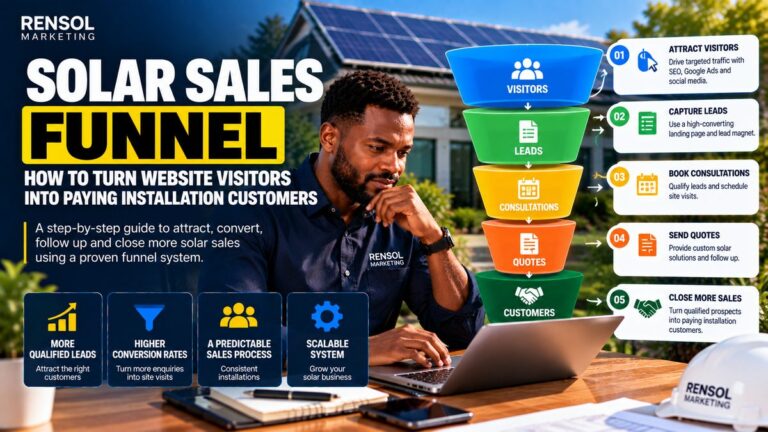
14. Measure the full funnel, not just lead volume
A campaign that generates many enquiries may still be unprofitable if few prospects qualify, attend appointments, accept proposals, or complete installations. If you work with an agency or lead vendor, compare options using our guide to solar lead generation companies.
Track these metrics by channel and campaign:
| Stage | Metric |
|---|---|
| Traffic | Visitors, clicks, and cost per click |
| Enquiry | Leads and cost per lead |
| Contact | Contact rate and time to first response |
| Qualification | Qualified lead rate |
| Appointment | Booking rate and show rate |
| Proposal | Site-assessment and quote rate |
| Sales | Close rate and signed contract value |
| Delivery | Installation completion and cancellation rate |
| Economics | Cost per acquired customer and gross profit after acquisition cost |
Define each metric consistently. For example, decide whether a “sale” means a signed contract, a deposit received, or a completed installation. Those milestones are not interchangeable. If you buy leads, it also helps to understand how exclusive solar leads differ from shared ones.
Use campaign tracking links, call tracking where appropriate, and CRM source fields. Ask new customers how they first heard about your business, while recognising that self-reported attribution is imperfect. Review both first-touch and later interactions rather than assuming one channel deserves all the credit.
15. Create a 90-day solar marketing action plan
A practical plan helps you build the foundation before scaling spend.
Days 1–30: Fix the basics
- Define your priority customer segments and service area.
- Review your website, enquiry forms, and mobile experience.
- Complete your business profile and update project photos.
- Set up CRM stages, lead-source tracking, and follow-up ownership.
- Ask recent satisfied customers for honest reviews and feedback.
- Interview sales staff about the questions and objections they hear most.
Days 31–60: Launch focused campaigns
- Publish or improve two to four high-value pages or articles based on customer questions.
- Create a focused landing page for one priority offer.
- Test one search campaign or social campaign with a controlled budget.
- Produce a few short videos from real projects or frequently asked questions.
- Start a referral request process for completed installations.
- Review enquiry quality and follow-up speed weekly.
Days 61–90: Improve and expand what works
- Compare campaign results through qualified leads, appointments, sales, and completed projects.
- Identify where prospects drop out of the funnel.
- Improve the landing page and sales follow-up based on actual objections.
- Build one or two relevant referral or commercial partnerships.
- Create a case study from a completed project, with customer permission.
- Increase budget only where the economics and operational capacity support it.
This is a starting framework, not a fixed timetable. A company with a strong website and CRM may move faster, while a new installer may need more time to gather proof and establish its processes.
Common solar marketing mistakes to avoid
Chasing volume instead of fit. A large number of enquiries is not useful if most are outside your service area or unable to proceed.
Making claims without evidence. Savings, payback, performance, and financing claims should be supported by transparent assumptions and accurate terms.
Using the same message for every audience. Residential and commercial buyers have different problems, decision processes, and information needs.
Ignoring the website after launching ads. Campaign performance depends on what happens after the click. Keep testing forms, page clarity, mobile usability, and trust signals.
Failing to follow up. A promising lead can go cold when nobody owns the next action.
Treating social media as a gallery. Project photos help, but explain the problem solved, the installation process, and the lessons learned.
Scaling before measuring. More budget can amplify a weak process. Establish conversion tracking and operational capacity before increasing spend.
Neglecting aftercare. Customer support affects reviews, referrals, and future opportunities. Marketing should not stop at installation day.
Frequently asked questions
What is the most effective marketing strategy for a solar installer?
There is no single channel that works best for every installer. Results depend on location, customer segment, budget, competition, and sales execution. A durable approach usually combines a trustworthy website, local visibility, useful content, referrals, targeted paid campaigns, and consistent follow-up. Measure each channel by qualified opportunities and completed projects.
How much should a solar company spend on marketing?
Set a budget based on cash flow, gross margins, available installation capacity, and the cost of acquiring customers. Start with a controlled test, calculate the full cost of acquisition, and increase investment only when the results support it. Published benchmarks from other markets can provide context, but they are not a substitute for your own numbers.
Are Facebook Ads good for solar companies?
They can help introduce offers, demonstrate projects, and generate enquiries. However, a form submission may not mean the person is ready to buy. Use clear targeting, honest creative, qualifying questions, and prompt follow-up. Compare performance with other channels using sales outcomes, not only the cost per form fill.
Does SEO still work for solar installers?
SEO can help customers find your business while researching costs, system options, and installation questions. It requires useful content, a technically sound website, local relevance, and time. Focus on answering real customer questions and demonstrating experience rather than publishing large volumes of generic pages.
How can a small solar installer compete with larger companies?
A smaller installer can focus on a well-defined service area, responsive communication, genuine project proof, clear proposals, and strong customer relationships. Local partnerships and referrals can also help. Avoid competing only on price if your service, workmanship, and support provide other meaningful value.
How long does solar marketing take to produce results?
Paid campaigns may generate enquiries soon after launch, but reliable performance takes testing and optimisation. SEO, referrals, and brand reputation generally develop over a longer period. The sales cycle also varies by project size and financing. Track early indicators and completed installations separately.
Final thoughts on Solar Marketing Strategies
Solar marketing works best as a connected system. Your positioning attracts the right audience. Your website and content answer questions. Search and social campaigns create visibility. Reviews and case studies build trust. Referrals and partnerships expand reach. Follow-up and clear proposals turn interest into projects. Measurement tells you where to improve.
Start with the customer and the problem you solve, not with the platform you want to post on. Build a process your team can execute consistently, test one initiative at a time, and use actual sales data to guide investment.
Want to build a more consistent solar customer pipeline? Rensol Marketing helps solar businesses plan and improve their acquisition systems, from campaign strategy and landing pages to lead tracking and follow-up. Visit Rensol Marketing to explore a tailored approach.
Sources and further reading
- Payaca: Solar marketing for install businesses, six strategies
- Daly Advertising: Solar marketing and lead generation strategies
- SolarVis: How to generate solar leads, a complete guide for installers
- LeadWise: Solar marketing ideas for installers
- SurgePV: Solar marketing strategies for consistent leads
External articles provide industry perspectives and examples, not guarantees. Confirm any market-specific claims, platform features, and regulatory requirements before applying them.
Quick solar marketing strategies checklist
- Pick a clear audience before you choose channels for your solar marketing strategies.
- Make the website answer buying questions and offer one specific next step.
- Keep your business profile and reviews active, because local trust supports your other solar marketing strategies.
- Publish content built from real sales questions to support your solar marketing strategies.
- Test search or social ads with a capped budget before scaling your solar marketing strategies.
- Add referrals and partnerships to your solar marketing strategies once the basics work.
- Follow up on every enquiry; the best solar marketing strategies fail without it.
- Review funnel metrics monthly and drop what does not produce installations.
The most effective solar marketing strategies are simple enough to run every week. Choose a small set of solar marketing strategies, assign owners, and review the numbers before adding more.
Write your solar marketing strategies down as a one-page plan with owners and dates.
Ask your sales team which solar marketing strategies bring the best conversations.
Retire solar marketing strategies that produce clicks but no qualified enquiries.
Revisit your solar marketing strategies every quarter.
A short 90-day plan keeps solar marketing strategies realistic.
Share results from your solar marketing strategies with the whole team.
Related reading
More guidance related to solar marketing strategies:




Want the Solar Marketing 90-Day Action Planner? Ask for it in a strategy conversation with Rensol Marketing. You can also read more on our blog.