A solar enquiry is not the same as a completed sale. Someone may request a quote, answer your first call, and then disappear for weeks. Another prospect may compare three installers, postpone the project until the next budget cycle, or need more information before involving a spouse, business partner, or finance manager.
When a lead goes quiet, it is tempting to mark it as lost and move on. But silence does not always mean rejection. The person may be busy, uncertain, waiting for funds, or simply not ready to make a decision.
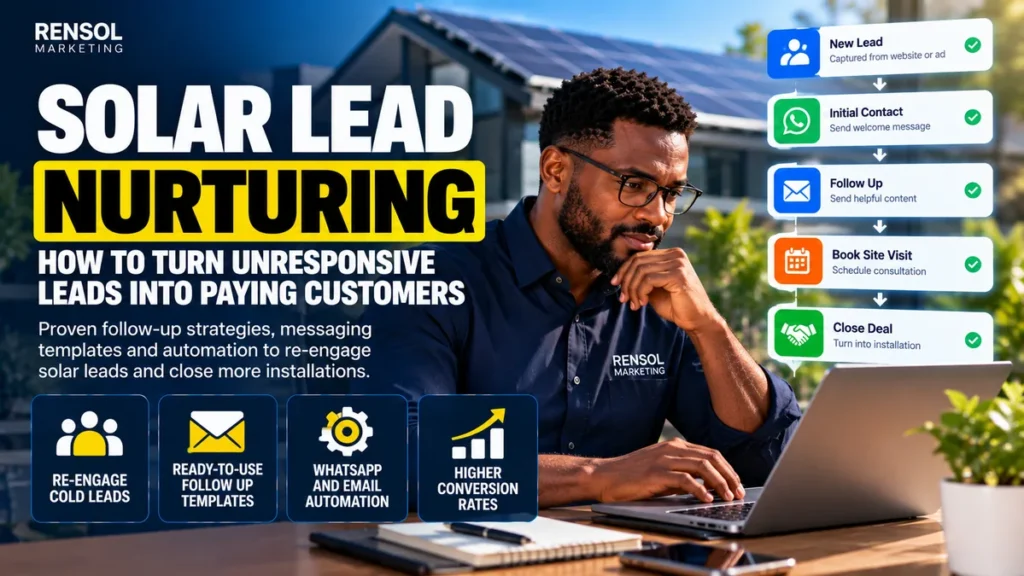
Solar lead nurturing is the process of staying useful and relevant to prospects over time, so they can return to the conversation when their needs, timing, or confidence changes. It is not about sending endless reminders. It is about delivering the right information, at a sensible pace, with a clear next step and respect for the customer’s preferences.
This guide explains how solar installers can build a practical nurturing system for new enquiries, unresponsive leads, prospects comparing quotations, and customers who are interested but not ready. It includes a sample cadence, message templates, automation ideas, CRM stages, and performance metrics.
Losing good enquiries to slow follow-up? Request a strategy conversation with Rensol Marketing to review your follow-up and lead tracking process.
Quick answer: In short, solar lead nurturing keeps you useful to prospects who go quiet, so they come back to you when timing or confidence changes. Done well, solar lead nurturing feels like help, not pressure.
Key takeaways
- Solar lead nurturing keeps you useful to prospects who go quiet, so they come back to you when timing or confidence changes.
- Segment leads by stage, send messages that answer a real question, and give every lead an owner and a next action.
- Measure booked assessments, proposals and installations, not messages sent.
Table of Contents
What is solar lead nurturing?
Lead nurturing is a structured process for developing relationships with people who have shown interest but have not yet become customers. For solar businesses, that may include someone who:
- Submitted a website form but did not answer the phone.
- Asked for a quote and then stopped responding.
- Completed a site assessment but has not reviewed the proposal.
- Is comparing different installers or system options.
- Wants solar but is waiting for a budget, roof repair, property decision, or financing.
- Is interested in the future but has no immediate installation date.
- Previously chose another provider but may have future energy needs.
Nurturing gives each of these prospects a relevant path instead of treating every quiet lead the same way.
A good system has five elements:
- Context: Record what the prospect asked for and what has happened so far.
- Segmentation: Group leads by need, readiness, project type, and current stage.
- Useful communication: Share information that answers likely questions or removes a barrier.
- Consistent follow-up: Assign an owner, a next action, and a reasonable timing.
- Measurement: Track appointments, proposals, sales, and customer experience, not just messages sent.
Why solar leads go quiet
Understanding why a prospect has stopped responding helps your team choose a better next step.
The prospect is busy
People submit forms between meetings, during work, or while researching several options. They may not be able to take a call when your salesperson responds. A short acknowledgement and a choice of callback times can make it easier to reconnect.
The customer is still researching
Solar involves technical and financial questions. A prospect may want to understand battery backup, system sizing, warranties, maintenance, financing, or how to compare quotations. If your follow-up only asks whether they are ready to buy, it does not help them make progress.
The project is not urgent
A homeowner may be planning for a future renovation. A business may need to wait for a budget approval. These leads may be valuable later, but they should move into a slower nurture track rather than receive daily sales messages.
The proposal is confusing
A customer may not understand what is included, why one system costs more than another, or which assumptions drive the estimated savings. A clear proposal walkthrough can be more effective than another discount.
The customer is speaking with competitors
Solar prospects often compare more than one installer. If your company does not explain its process, workmanship, aftercare, and proposal assumptions, the customer may compare only the headline price.
The lead was never a good fit
Some enquiries are outside your service area, lack property permission, have unrealistic expectations, or do not match the systems you install. Nurturing cannot fix every mismatch. Qualify leads early and disqualify them respectfully when necessary. Qualification matters just as much for exclusive solar leads as for shared ones.
Respond quickly, then continue thoughtfully
The first response should acknowledge the enquiry and make the next step clear. A fast response is useful because the customer remembers why they contacted you, but speed alone does not guarantee a sale. The quality and relevance of the conversation matter too. For the full acquisition picture, see our guide on how to get more solar installation leads.
Set an internal service target your team can consistently meet. For example, aim to acknowledge new enquiries promptly during business hours and make a personal contact attempt as soon as practical. If your team cannot answer immediately, use an honest automated confirmation that states when a person will follow up.
Do not promise a callback in five minutes if nobody is assigned to deliver it. Reliability builds more trust than an impressive promise that is missed.
Segment leads before building automations
A single follow-up sequence for every lead usually creates irrelevant messages. Start with a few practical segments.
| Segment | Typical situation | Suitable next step |
|---|---|---|
| New enquiry | Just requested information | Acknowledge, contact, qualify |
| No response | Contact attempts have not connected | Vary timing and channel, then slow down |
| Qualified, not booked | Needs appear relevant but no appointment | Offer simple booking options |
| Site visit booked | Assessment is scheduled | Confirm details and send preparation checklist |
| Proposal delivered | Customer is reviewing an offer | Walk through scope, assumptions, and questions |
| Comparing options | Prospect is reviewing other quotes | Provide a fair comparison checklist |
| Deferred | Interested but timing or budget is later | Agree on a future check-in |
| Lost to competitor | Chose another provider | Close respectfully; contact later only if appropriate |
| Disqualified | Not a fit or asks not to be contacted | Record reason and stop sales outreach |
Use the customer’s actual words when recording a reason for delay. “Not ready” is less useful than “wants to revisit after roof repairs in March.” Business buyers need a longer rhythm; see our guide to commercial solar lead generation.
A practical solar lead nurturing sequence
The cadence below is a starting framework, not a universal rule. Adjust it to your team’s capacity, the lead source, customer expectations, local communication laws, and the customer’s preferred channel. Stop immediately when someone opts out or asks not to be contacted.
Day 0: Acknowledge the enquiry
Send a short confirmation that identifies your company, reflects the request, and explains what happens next.
Example:
“Hi {{first_name}}, thanks for contacting {{company_name}} about solar for your {{home/business}}. We have received your request. A member of our team will reach out to understand your needs and explain the next step. If there is a convenient time for a call, you can reply here.”
Day 0 or 1: Make a personal contact attempt
Call at a reasonable time. If the prospect does not answer, leave a brief voicemail where appropriate and send a concise follow-up message. Avoid making multiple calls in a short period simply to force a response.
Example:
“Hi {{first_name}}, this is {{rep_name}} from {{company_name}}. I am following up on your solar enquiry. I would like to ask a couple of questions about your energy needs and see whether an assessment would be useful. Is there a good time to speak?”
Day 2: Offer a useful answer
Do not repeat the first message word for word. Share a short resource related to the customer’s likely question, such as a system-sizing guide, an explanation of battery backup, or a checklist for comparing proposals.
Example:
“Hi {{first_name}}, one question that often comes up when comparing solar options is how much backup a battery can provide. We have a simple guide that explains the main factors. Would you like me to send it?”
Day 4 or 5: Ask one easy question
A simple question can reveal whether the lead is still active and what is preventing progress.
Example:
“Just checking whether solar is still something you are considering. Is your main priority reducing electricity costs, improving backup, or understanding the options first?”
Day 7: Offer a clear next step
If the prospect is qualified, make it easy to book a consultation or site assessment. Offer a small number of genuine options rather than an open-ended request.
Example:
“If it would help, we can arrange a short call to review your requirements before recommending a system. Would a weekday morning or afternoon suit you better?”
Day 14: Close the active sequence politely
If there has been no response, tell the person you will stop the frequent follow-up. This shows respect and gives them an easy way to re-engage.
Example:
“Hi {{first_name}}, I have not been able to reach you, so I will pause my follow-ups for now. If you decide to revisit solar, you can reply to this message and we will be happy to help. Thank you for considering {{company_name}}.”
After Day 14: Move suitable leads into slower nurture
Only keep sending marketing updates when you have the appropriate consent or other lawful basis. A monthly educational email may suit some prospects, while others may prefer no further contact. Respect channel preferences and unsubscribe requests.
The objective is not to hit a fixed number of touches. It is to create a process that is persistent enough to be useful and restrained enough to preserve trust.
Follow up differently at each sales stage
A lead’s needs change as they move through the funnel. Use stage-specific communication.
After a site assessment
Confirm what was observed, what information is still needed, and when the customer can expect the proposal. If technical review will take longer than expected, tell them before the promised date passes.
After sending a quotation
Do not send a bare “Did you see my quote?” message. Offer to explain the design, equipment, assumptions, exclusions, warranty, and next steps.
Example:
“Hi {{first_name}}, I wanted to make sure you received the proposal. I am happy to walk through the system recommendation, what is included, and any questions you have about the estimate. Would a short call be useful?”
When the customer is comparing quotes
Help the prospect compare like with like. Explain differences in system size, component specifications, workmanship, warranties, monitoring, installation scope, and aftercare. Avoid attacking competitors or making claims you cannot verify.
When price is the objection
Ask whether the concern is the total price, payment timing, perceived value, or uncertainty about the return. If appropriate, present options with clearly explained trade-offs. Do not reduce price automatically before understanding the objection.
When timing is the objection
Record the customer’s preferred revisit date and the reason. Create a reminder that matches their timeline. Do not continue sending weekly sales messages to someone who has clearly said they will revisit in several months.
When the prospect chooses another installer
Thank them for the opportunity and close the active sales sequence. If they have agreed to future contact, you may check in later in a respectful way. Do not imply that their chosen provider will fail or use fear to reopen the conversation.
Use education to build confidence
The best nurture content answers a real question. Create a small library of resources your sales team can send based on what the prospect needs.
Useful topics include:
- How to estimate the right system size.
- What determines battery runtime.
- How to compare solar quotations fairly.
- What is included in a site assessment.
- Questions to ask about workmanship and equipment warranties.
- How installation and commissioning work.
- What maintenance is required.
- How financing terms affect total project cost.
- What can change estimated savings or payback.
- How to prepare a commercial site for a feasibility review.
Keep resources easy to understand. Use diagrams, short videos, checklists, and plain-language explanations. Make clear when an estimate is preliminary and when a qualified technical assessment is required. More content ideas are in our list of ways to generate solar leads without buying them.
Automate reminders, not relationships
Automation can help a small solar company respond consistently, but it should not make every interaction feel robotic.
Good automation use cases include:
- Confirming that an enquiry was received.
- Assigning a lead to the right salesperson.
- Creating a task when a new enquiry arrives.
- Reminding staff to call or send a proposal.
- Sending appointment confirmations and preparation details.
- Flagging a proposal that has not received a follow-up.
- Moving a lead into a slower nurture track after the active sequence ends.
- Recording opt-outs and preventing further marketing messages.
Keep human involvement for technical questions, complaints, negotiation, unusual circumstances, and important buying decisions. Review automated messages regularly so they reflect current services, pricing, policies, and availability. It also fits into wider solar marketing strategies for installers.
Build a simple CRM structure
A CRM does not need to be complicated to be useful. At minimum, record:
- Lead name and business or property type.
- Contact details and preferred channel.
- Enquiry source and date.
- Customer need and location.
- Qualification status.
- Current sales stage.
- Last contact date and outcome.
- Objections or reasons for delay.
- Next action, due date, and assigned owner.
- Consent or communication preference where applicable.
- Final outcome and reason for loss or disqualification.
Use consistent status names so your reports are meaningful. Train the team to update records after each interaction, not at the end of the week from memory.
Measure whether nurturing is working
Do not measure success only by open rates, message counts, or the number of tasks completed. Those indicators can help diagnose a process, but the business outcome is whether suitable leads progress.
Track metrics such as:
| Metric | What it tells you |
|---|---|
| Time to first response | How quickly the team acknowledges enquiries |
| Contact rate | How often the team reaches a prospect |
| Reply rate by sequence stage | Which messages invite a response |
| Appointment booking rate | Whether follow-up moves prospects toward a conversation |
| Appointment show rate | Whether booked meetings actually happen |
| Proposal follow-up rate | Whether every quote receives a planned next action |
| Reactivation rate | How many older leads re-engage |
| Lead-to-sale conversion | How many leads become customers |
| Sales from older leads | Whether long-term nurture contributes revenue |
| Opt-out and complaint rate | Whether the cadence is too frequent or poorly targeted |
| Revenue and gross profit by source | Whether the process supports business economics |
Compare results by lead source, customer segment, and sales stage. A sequence may work well for residential enquiries but need a different rhythm for commercial projects. If your leads come from a vendor, our guide to solar lead generation companies explains what to check.
Use a sufficiently large sample and a reasonable time window before drawing conclusions. A small number of conversions can make percentages look dramatic without proving a repeatable result. Our guide to solar lead generation costs and ROI shows how to connect these metrics to acquisition cost.
Common lead nurturing mistakes
Stopping after one or two attempts. Some prospects simply miss calls. Create a defined, respectful sequence and a clear point at which active follow-up ends.
Sending the same message repeatedly. Each touch should have a purpose, such as answering a question, offering a resource, confirming a next step, or closing the loop.
Over-automating. A scheduled message that ignores the customer’s latest reply can damage trust. Pause or update sequences when a person responds.
Ignoring consent and opt-outs. Follow applicable privacy, telemarketing, and messaging rules. Honour requests to stop, and do not use purchased contact lists without confirming the lawful basis and platform requirements.
Treating every lead as equally ready. Separate urgent enquiries from long-term prospects and disqualified contacts.
Failing to record context. A follow-up that says “checking in” without remembering the customer’s concern makes the company appear disorganised.
Using pressure instead of value. False scarcity, unsupported savings claims, and repeated demands for a decision can undermine trust.
Failing to measure sales outcomes. A sequence is not successful simply because it sends messages. Track booked assessments, proposals, contracts, completed installations, and customer feedback.
Want ready-made templates? Ask for our Solar Lead Follow-Up Template Pack in a strategy conversation with Rensol Marketing.
A 30-day implementation plan
Week 1: Audit your current leads
Review enquiries from the last 90 days. Categorise them by stage, source, response status, reason for delay, and final outcome. Identify leads that have no next action and check whether they can appropriately be re-engaged.
Week 2: Create the first sequences
Build separate workflows for new enquiries, no-response leads, proposal follow-up, and deferred prospects. Write a small set of helpful messages and have your sales team review them for tone and accuracy.
Week 3: Configure the CRM and automation
Set up task ownership, reminders, consent fields, opt-out handling, and reporting. Test the process with internal records before using it with customers. Make sure a human can pause or correct a sequence.
Week 4: Launch, review, and improve
Start with a manageable group of leads. Review response quality, booked appointments, complaints, and staff workload. Ask salespeople which messages helped and which felt unnatural. Improve the workflow before expanding it.
Frequently asked questions
How many times should a solar company follow up with a lead?
There is no universally correct number. A short active sequence over roughly one to two weeks can provide several chances to connect, after which suitable prospects may move to a slower, consent-based nurture plan. The right cadence depends on customer expectations, channel, sales cycle, and local rules. Stop when a person opts out or asks not to be contacted.
How often should I send nurturing emails?
Send only as often as you can provide genuinely useful information. For many businesses, a monthly educational update is a reasonable starting point for prospects who have agreed to receive it. Monitor engagement, unsubscribes, and complaints, and let people control their preferences.
Should solar lead nurturing use WhatsApp, SMS, email, or phone calls?
Use the channel the prospect prefers and that is appropriate for the message. Calls are useful for complex conversations, messaging can make scheduling easier, and email is suitable for detailed guides or proposals. Follow platform rules and local consent requirements, especially for automated marketing.
What should I say to a solar lead who is not responding?
Keep it brief, identify your company, reference the original enquiry, and make replying easy. Offer a useful resource or ask whether the timing is wrong. Avoid guilt, pressure, or repeated messages that add no value.
Can automation close solar sales?
Automation can acknowledge enquiries, organise follow-up, remind staff, and deliver relevant information. It cannot replace a proper technical assessment, accurate proposal, human judgement, or customer trust. Use it to help your team respond consistently, not to remove human support from important decisions.
How do I reactivate old solar leads?
First review the record and confirm that re-contact is appropriate. Segment by original need and reason for delay. Send a relevant, low-pressure message that acknowledges the time gap and offers a useful next step. Do not assume the customer’s circumstances are unchanged, and stop if they decline.
Final thoughts on Solar Lead Nurturing
Solar lead nurturing turns follow-up from an improvised task into a customer experience. It helps your team respond consistently, answer questions, keep proposals moving, and stay available to people whose timing changes.
Start with a few clear segments, write messages that are useful on their own, assign every next action, and respect customer preferences. Use automation for reminders and routine administration, while keeping people involved where expertise and trust matter.
Most importantly, measure the outcomes that matter: qualified conversations, site assessments, proposals, completed installations, and customer experience. A good nurturing system does not simply send more messages. It helps the right customer take the next step when they are ready.
Want to stop losing valuable solar enquiries to inconsistent follow-up? Rensol Marketing helps solar businesses improve lead tracking, messaging, landing pages, and follow-up workflows. Visit Rensol Marketing to explore a tailored approach.
Sources and further reading
- Solar Insights: The first hour after a lead lands
- Volt: How many times to follow up with a solar lead
- SecureMyLead: How solar installers should follow up with leads
- Volt: Solar lead nurturing for long decision windows
- SolarSwytch: Solar lead follow-up cadence that converts
These sources offer practitioner perspectives and suggested workflows. Cadence examples are not universal rules. Adapt communication to customer preferences, your actual sales cycle, and applicable privacy and messaging requirements.
Quick solar lead nurturing checklist
- Segment leads by stage before you build any solar lead nurturing sequence.
- Send messages that answer a real question rather than repeating “checking in”.
- Give every lead an owner, a next action and a date.
- Respect consent, opt-outs and the channel each person prefers in your solar lead nurturing.
- Pause automated solar lead nurturing as soon as a prospect replies.
- Measure booked assessments, proposals and sales, not messages sent.
Consistent solar lead nurturing turns forgotten enquiries into future customers. Keep the sequence short, helpful and measurable, and review your solar lead nurturing results every month.
Start your solar lead nurturing with the leads you already have: old quotes and unanswered enquiries.
Let your CRM remind your team when solar lead nurturing tasks are due.
Related reading
More guidance related to solar lead nurturing:






Ready to fix your follow-up? Request a strategy conversation with Rensol Marketing to review your lead tracking, messaging and follow-up workflows. Read more on our blog.