Solar installation companies need more than a steady stream of enquiries. They need a repeatable way to attract people who are ready to invest, qualify those prospects, and move them from first contact to a completed installation. A campaign can generate hundreds of form submissions and still fail if the leads are poorly matched, follow-up is slow, or the sales process is unclear.
The most reliable approach is to build a customer acquisition system rather than depend on one advertising channel. That system combines a clear offer, targeted traffic, a useful landing page, fast follow-up, consistent sales conversations, and measurement at every stage. This guide explains how solar installers can build that system in 2026, whether they serve homeowners, commercial properties, or both.
Want a second opinion on your pipeline? Rensol Marketing offers solar lead generation services for installers. Request a strategy conversation to review your lead generation and sales process.
Quick answer: In short: solar installation leads are only valuable when your team can contact them, qualify them and book an assessment. This guide shows how to attract better solar installation leads and turn more of them into completed projects.
Key takeaways
- Solar installation leads turn into customers when your offer, landing page, follow-up and tracking work together.
- Qualify enquiries early and respond fast, because prospects often contact several installers.
- Measure the whole journey from enquiry to completed installation, not just lead volume.
Table of Contents
1. Define the customer you actually want
Before spending money on advertising, decide which customers are most valuable to your business. A residential installer and a commercial solar contractor may both sell solar systems, but their buyers have different needs, budgets, and decision processes.
For residential projects, useful qualification factors include property ownership, average electricity bill, location, roof suitability, current power reliability, and the customer’s preferred installation timeline. For commercial projects, qualification may include monthly energy expenditure, operating hours, load profile, decision-maker access, available capital, and whether the business is considering outright purchase or financing.
Create a simple ideal-customer profile for each market. Avoid defining your audience only by age or income. A business owner who spends heavily on diesel and experiences frequent outages may have a stronger reason to explore solar than someone with a higher income but low energy costs.
Write down the signals that indicate genuine intent. Examples include asking for a site assessment, sharing a recent electricity bill, requesting a system design, or asking about payment options. These signals can help your team prioritise follow-up and help your marketing campaigns attract better-fit prospects.
2. Lead with a specific offer
Many solar ads use broad messages such as “Go solar today” or “Contact us for solar.” These statements explain the category, but they do not give a prospect a compelling reason to respond now.
A stronger offer promises a useful next step without making unrealistic claims. Examples include a free preliminary energy assessment, a custom system recommendation, a bill review, a site suitability check, or a consultation about financing options. The offer should be something your team can deliver consistently and explain clearly.
Be precise about what is included. If a free assessment is remote and preliminary, say so. If a detailed design requires a site visit, explain that. Transparent offers help reduce confusion and attract prospects who understand the process.
Avoid guaranteeing a particular percentage of savings or a fixed payback period before reviewing the customer’s load, tariff, equipment, installation conditions, and financing costs. Instead, explain that savings and payback depend on the customer’s actual circumstances. This protects trust and sets realistic expectations.

3. Build a landing page for one audience and one action
Sending every ad click to a general homepage creates unnecessary friction. A dedicated landing page can speak directly to the audience and offer featured in the campaign.
A high-converting solar landing page should include:
- A headline that describes the outcome or problem being addressed.
- A short explanation of who the service is for.
- The main offer and what the prospect receives.
- Proof such as genuine testimonials, project photographs, certifications, or case studies.
- A simple form that asks only for information needed to qualify and respond.
- A clear privacy statement explaining how contact details will be used.
- A direct call to action, such as “Request an energy assessment.”
- Answers to common concerns about installation, warranties, maintenance, and payment.
For a residential campaign, the form might ask for name, phone number, location, property type, and a rough electricity-spend range. For commercial enquiries, you may also ask about business type, operating hours, and whether the prospect is the decision-maker. Do not make the first form so long that interested people abandon it. Collect additional details during the follow-up conversation.
Our solar marketing services start with exactly this kind of focused landing page. Make the page mobile-friendly. Many prospects will arrive from social media on a phone. Test the page on a real mobile device, check that buttons are easy to tap, and ensure that forms work reliably.
4. Use search advertising to reach active demand
Search advertising (see Google Ads Help for setup guidance) can connect your company with people already looking for a solar installer, a quote, or a solution to an energy problem. It is especially useful when the search term reflects a clear commercial need.
Organise campaigns around distinct services and locations. For example, residential installation, commercial solar, battery backup, and solar maintenance may deserve separate campaigns or ad groups. This makes it easier to align the ad, landing page, and follow-up questions with the searcher’s intent.
Use location targeting that reflects where your team can actually install and support systems. If you serve only selected cities or regions, avoid paying for clicks from areas you cannot reach. Review search-term reports regularly and add negative keywords for irrelevant searches, such as school assignments, jobs, or do-it-yourself research when those are not part of your business.
Measure more than clicks. Track qualified enquiries, site assessments booked, quotations delivered, signed contracts, and revenue. A campaign with a higher cost per lead may still be more profitable if it produces larger projects and better close rates.
5. Use social advertising to create demand
Social platforms, including the tools in Meta Business, can help solar companies reach homeowners, business owners, and property decision-makers who may not be actively searching for an installer yet. The creative needs to make the problem and next step immediately clear.
Test several creative angles rather than relying on one advertisement. Possible angles include reducing dependence on fuel, improving power reliability, understanding the cost of a system, seeing a completed installation, or learning whether a property is suitable for solar. Match each angle to a relevant audience and landing page.
Use real project images and customer stories whenever possible, with permission. Authentic photographs of installations, equipment, and the team can help establish credibility. Avoid using stock images that imply your company completed work it did not perform.
Do not judge a campaign only by the number of leads. Review lead quality by source, creative, audience, and location. If one ad produces many enquiries but few qualified conversations, revise the message or qualification process instead of simply increasing the budget.
6. Respond quickly and make follow-up useful
A lead is not a sale. Prospects may contact several installers, and the company that responds clearly and promptly can earn the opportunity to understand the project first.
Set a response-time standard your team can consistently meet. Send an immediate confirmation that acknowledges the enquiry and explains what will happen next. Then have a person contact the prospect as soon as practical during business hours. If a call is missed, use a polite message to offer a convenient time to speak.
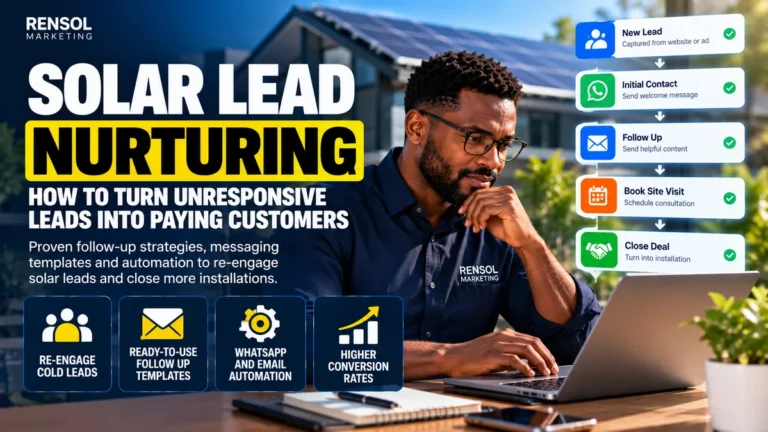
Follow-up should add value rather than repeat “Are you ready to buy?” A useful sequence might include:
- A confirmation and a request for the best time to talk.
- A brief explanation of the assessment process.
- A checklist of information that helps prepare an accurate recommendation.
- Answers to a concern the prospect raised.
- A reminder to book the next step.
- A respectful final check-in that allows the prospect to pause contact.
Use the channel the prospect has agreed to receive, and follow applicable messaging and privacy rules. Make it easy to opt out. Solar sales and follow-up automation can help with reminders and task assignment, but it should not make the conversation feel impersonal or send messages without appropriate consent.
Is slow follow-up costing you installations? Download our Solar Lead Generation and Follow-Up Checklist by asking for it in a strategy conversation with Rensol Marketing.
7. Qualify leads before investing extensive sales time
A practical qualification process helps sales teams focus their effort while treating every prospect respectfully. It should identify fit and readiness, not pressure people into a decision.
For a residential enquiry, ask about the property, the main energy challenge, typical usage, location, and desired timeline. For a commercial enquiry, explore the business’s energy costs, operating pattern, outage impact, decision process, and budget approach. Explain why you are asking and how the answers will improve the recommendation.
Record the answers in a CRM or structured spreadsheet. Use consistent fields so that leads can be compared and handed between team members without losing context. A simple status pipeline might include New Enquiry, Contact Attempted, Qualified, Assessment Booked, Assessment Completed, Quote Sent, Follow-Up, Won, Lost, and Nurture.
Do not disqualify a prospect solely because they are not ready this week. Some projects require internal approval, financing discussions, or property work. With permission, place longer-term prospects into a relevant nurture sequence and set a date to check back.
8. Make the site assessment and quotation part of the sales experience
The site visit is not merely a technical task. It is an opportunity to understand the customer’s priorities, explain trade-offs, and build confidence in your recommendation.
Before the visit, confirm the appointment, explain who will attend, and share any information the customer should prepare. During the assessment, ask about the customer’s most important loads, expected backup duration, future expansion, and concerns about maintenance or warranties. Explain what can be confirmed on site and what requires further analysis.
A strong quotation should be easy to understand. It should describe the proposed system, major components, assumptions, scope of work, exclusions, warranties, payment terms, estimated timeline, and after-sales support. Where appropriate, present options with clear differences rather than overwhelming the customer with technical specifications.
Explain the basis of any estimated savings or payback figures. Identify assumptions such as energy usage, tariffs, fuel costs, operating hours, and financing. A transparent proposal may take more care to prepare, but it helps customers make an informed comparison and reduces disputes later.
9. Build trust with proof and education
Solar is a considered purchase. Prospects may worry about equipment quality, installer reliability, system performance, maintenance, and what happens if something goes wrong. Your website and sales process should address these questions before they become objections.
Publish genuine case studies (see our solar marketing case studies) that explain the customer’s situation, the system installed, the scope of work, and the outcome. Include dates and relevant context. Do not present one customer’s result as a guarantee for every project.
Create educational content that answers real questions: how to compare quotations, what affects system size, what batteries can and cannot do, how maintenance works, and which questions to ask an installer. Clear educational content (the Google Search Central SEO Starter Guide is a good reference) can attract search traffic while helping sales conversations become more productive.
Display certifications, licences, warranties, and partner relationships accurately. Never imply an endorsement or accreditation that your company does not hold. Trust is built through verifiable details and consistent service, not exaggerated claims.
10. Track the metrics that connect marketing to revenue
A lead-generation system needs a measurement framework. At minimum, track:
- Leads by channel and campaign.
- Percentage of leads successfully contacted.
- Percentage that meet your qualification criteria.
- Assessments booked and completed.
- Quotations sent.
- Quote-to-sale conversion rate.
- Average project value.
- Cost per qualified lead.
- Customer acquisition cost.
- Revenue and gross margin by channel.
Define each metric consistently. For example, decide whether a “lead” means a form submission, a unique person, or a verified contact. Without clear definitions, reports can look impressive while hiding weak performance.
Review the pipeline weekly. Look for bottlenecks. If leads are plentiful but few answer calls, examine response time and contact details. If assessments happen but quotes are not accepted, review proposal clarity, pricing, qualification, and follow-up. If one channel produces profitable projects, consider expanding it gradually while monitoring quality.
Use Google Analytics for website measurement and a CRM that fits the size and complexity of your team. A simple, consistently updated system is more useful than an advanced platform that nobody maintains.
11. Create a referral and review process
Satisfied customers can become a valuable source of new business. Build referral requests into the customer journey instead of relying on occasional reminders.
After commissioning and handover, ask whether the customer is comfortable sharing feedback. Provide a simple link or instructions for leaving an honest review. If the customer is happy with the experience, ask whether they know another property owner or business that may benefit from an assessment. Do not offer incentives in ways that violate the review platform’s policies, and never pressure customers to leave only positive feedback.
Respond professionally to reviews, including critical ones. A thoughtful response can show future customers that your company takes concerns seriously and is willing to resolve problems.
12. A practical 30-day action plan
You do not need to rebuild your entire marketing operation in one week. Start with a focused plan:
Week 1: Clarify the offer and audience. Choose one customer segment, define your service area, write the ideal-customer profile, and create one clear offer. Review the questions your sales team hears most often.
Week 2: Improve the conversion path. Build or update a dedicated landing page, test the form on mobile, configure lead notifications, and make sure every enquiry has an owner.
Week 3: Fix follow-up and tracking. Establish a response-time standard, write a short follow-up sequence, create CRM stages, and record the source of every enquiry.
Week 4: Launch, review, and improve. Run a controlled campaign, review lead quality and pipeline movement, speak with sales staff about objections, and make one or two evidence-based improvements. Avoid changing every variable at once, because that makes it difficult to learn what worked.
Conclusion: Winning More Solar Installation Leads
Getting more solar installation leads is not simply a matter of increasing advertising spend. Sustainable growth comes from attracting the right prospects, making a relevant offer, providing a clear conversion path, responding promptly, qualifying fairly, and managing the sales process with discipline.
Start by measuring the journey from first enquiry to completed installation. Then improve the weakest stage before scaling the budget. When marketing, sales, and operations work from the same customer information, your company can make better decisions, deliver a more consistent experience, and build a pipeline that is easier to forecast.
If your solar company wants to improve lead generation and conversion, Rensol Marketing can help you review your current acquisition process and identify practical opportunities for growth. Request a strategy conversation to discuss your market, goals, and next steps.
Quick solar installation leads checklist
- Define your ideal customer so solar installation leads match your service area and system type.
- Publish one clear offer that gives solar installation leads a reason to enquire today.
- Send every ad to a landing page built for one audience and one action.
- Reply quickly, because solar installation leads often speak to several installers.
- Qualify early so your team spends time on solar installation leads that can realistically proceed.
- Track solar installation leads from first enquiry to completed installation, not just form fills.
- Review the pipeline weekly and fix the weakest stage before raising your budget.
Strong solar installation leads rarely come from one tactic. They come from a connected system of offer, page, follow-up and measurement. Start small, measure honestly, and improve your solar installation leads process one stage at a time.
If you are unsure where to begin, audit your last 20 solar installation leads and note how many were reached, qualified and booked.
Share the results with your sales team so everyone agrees what good solar installation leads look like.
Revisit your solar installation leads numbers every month and adjust your offer accordingly.
Related reading
More guidance related to solar installation leads:





Ready to grow your solar pipeline? Request a strategy conversation with Rensol Marketing to review your solar company’s lead generation and sales process. You can also read more on our blog.